First used on the MX-81, the Mazda MX prefix has been used on production, concept and race cars.
In the year that the Mazda MX-30 has gone on sale in the UK, Mazda Italy has carried out a restoration of the first Mazda to wear the MX badge – the Mazda MX-81 Aria.
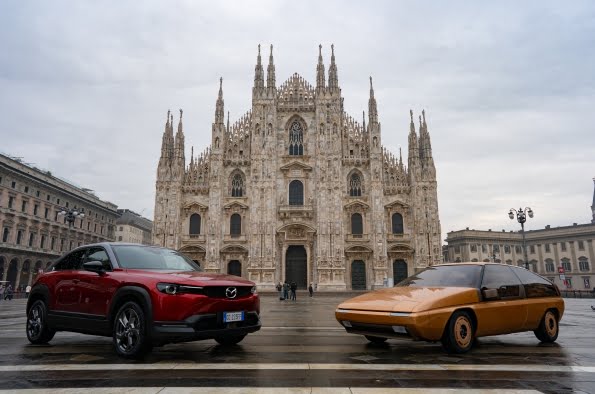
Returned to its original futuristic glory 40 years after its unveiling at the 1981 Tokyo Motor Show, the small wedge-shaped coupe was designed by Marc Dechamps for Turin based coachbuilder Bertone, and as the first Mazda to wear the MX badge, this bold concept car established the MX prefix that continues to be given to Mazdas that take on a challenge to create and deliver new values without being confined by convention regardless of vehicle type.
The story of the MX-81 restoration and the relationship between Mazda and Italian design
To create the Mazda MX-81 Aria concept car Bertone used Mazda 323 running gear and built a futuristic wedge-shaped hatchback. With its gold paint, huge glasshouse and pop-up lights it stood out at the 1981 Tokyo Motor Show, but with its recessed square steering wheel, TV screen cockpit and side swinging front seats, it was arguably the interior that was the most radical. A one-off concept that certainly met the defy convention ethos of MX models, it led to things like the high-mounted taillights and pop-up headlamps appearing in future Mazda production cars later in the eighties.
While lots of prototypes and concepts are destroyed once exhibited, in 2019 Nobuhiro Yamamoto – the former fourth-generation MX-5 programme manager and rotary engine developer – found the MX-81 in a warehouse at Mazda’s Headquarters in Hiroshima. From this discovery came the idea to restore the car and it was shipped to Mazda Italy, from where it has been painstakingly restored by SuperStile in Turin under the coordination of Flavio Gallizio. Fittingly, the completion of the restoration was celebrated by the recreation of the original press images of the MX-81 in front of Milan Cathedral.
However, the connection between Mazda and Italian design celebrated by the restoration of the MX-81 actually started 20 years before this radical concept was revealed at the 1981 Tokyo Motor Show. In 1960 Hideyuki Miyakawa, a young automotive writer, travelled to Italy and the Turin Motor Show where he met Giorgetto Giugiaro, the Head of Design at Bertone. He also met his future wife, Marisa Bassano – a Japanese-Italian translator with a passion for cars. During Marisa’s study trip in Hiroshima in 1961, Miyakawa met Mazda chairman Tsuneji Matsuda and the pair discussed the importance of design in the Japanese car industry.
Back in Turin, Hideyuki and Marisa began working as intermediaries between the legendary Italian design studios of Bertone, Ghia and Pinifarina and the Japanese car manufacturers. The collaboration between Mazda and Bertone they helped to facilitate led to Giugiaro designing the Mazda Familia and Luce models of the 1960s, plus the stunning R130 Luce Coupe of 1969. The relationship with Bertone continued even after Giugiaro left to work for Ghia, and the restoration of the Bertone created 1981 Mazda MX-81 Aria is a great celebration of that partnership.
However, the Mazda MX-81 was only the beginning of the story of the MX badge, which has been used more than a dozen times across a broad spread of production, concept and racing Mazdas.
Next in the MX lineage after the MX-81 was the 1983 MX-02 concept car, a big flat sided five-door hatch with large windows, aerodynamic rear wheel covers and flared in door mirrors. Unique features included rear wheel steering and a windscreen head-up display. The one-off theme continued with the 1985 Mazda MX-03, which again was a radical looking concept car, but this time it was a defy convention sports car that was powered by a triple rotor 315ps engine. Conceived purely as a concept, this low-slung coupe, was pure futuristic exuberance, with a cabin that featured an aircraft style yoke rather than a wheel, plus digital displays and a head-up display, its technology tally also including four-wheel steering and all-wheel drive, while the long low body delivered an aerodynamic Cd figure of just 0.25.
While the MX-02 and MX-03 shared some of the same futuristic design cues, the MX-04 was completely different. Revealed at the 1987 Tokyo Motor Show, the MX-04 was a front-engine rear-wheel drive sports car chassis that had removable fibreglass panels, but not just one, but two different sets, allowing the car to switch from a glass dome roofed coupe to a beach buggy style open sided roadster. Powered by a rotary engine this barmy shape-shifting sports car was never a serious contender for production, but little did outsiders know that Mazda was already developing the MX-5, and just two-years later, the most famous car to wear a MX badge arrived.
The next cars to wear the MX badge were the MX-3 and MX-6 production coupes, both built on the MX-5’s success and offered very different coupe styles, but in the 1990s arguably the most radical car to wear the MX badge was the Mazda MXR-01. After the rotary powered Mazda 787B took victory in the 1991 Le Mans 24 Hours, the FIA promptly banned rotary powered cars, leaving Mazda looking for a new car for the 1992 World Sportscar Championship at very short notice. A solution arrived in the shape of the incredible Mazda MXR-01 prototype race car. Based on the previous seasons Jaguar XJR-14, the British firms’ withdrawal from sportscar racing, allowed Mazda to adapt this radical Ross Brawn designed prototype and fit a Mazda badged V10 Judd engine. Famed for its incredible grip and downforce, just five examples where built, but sadly the collapse of the World Sportscar Championship at the end of 1992 spelt the end of Mazda’s world level motorsport programme and denied the MXR-01 the chance of success.
Into the 21st century the MX moniker returned to adorn concept cars: the 2001 MX-Sport Tourer concept was a radical MPV concept with freestyle doors and sweeping body design, that highlighted the fact an MPVs did not have to be boxy or dull, something the resulting Mazda5 proved. In fact, the 2004 Mazda MX-Flexa was a concept that was even closer to the final ground-breaking Mazda5 production car, sharing its popular sliding rear doors.
The 2002 MX-Sport Runabout concept previewed the modern look of the second-generation Mazda2, the 2003 MX-Sportif was the concept that previewed the first generation Mazda3 and the MX-MicroSport was a US focused hatchback concept revealed at the 2004 Detroit Motor Show. But the nineties MX concept that really started Mazda on the road to another success story, was the 2005 MX-Crossport. Inspired by the Mazda RX-8 sportscar this was a sporty looking SUV concept with sculpted wheel arches, slender headlamps and bold shoulder lines that previewed the Mazda CX-7 – a pivotal car that established a lineage of award-winning SUVs that leads to today’s CX-5, CX-30 and MX-30.
So 40 years after its debut, the restoration of the first ever MX model has appropriately allowed the MX-81 Aria to sit alongside the Mazda MX-30 – a car that represents a new chapter in Mazda’s history.
Citroën UK introduces ‘Sense’ entry level variant to New C4 range, set to arrive in May 2021 with prices starting from just £21,010 OTR.
New C4 ‘Sense’ trim joins existing ‘Sense Plus’, ‘Shine’ and ‘Shine Plus’ trims, giving consumers even more choice.
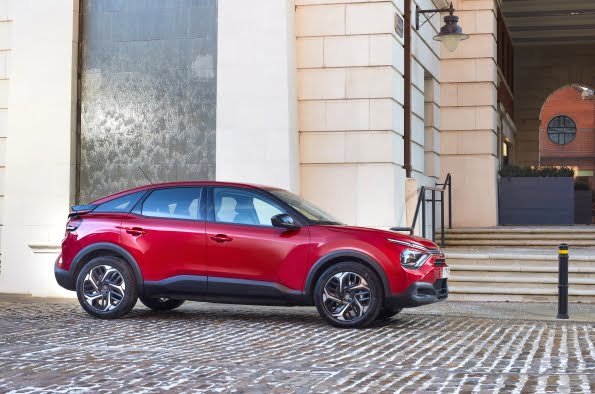
‘Sense’ models enjoy a wealth of standard specification, including Citroën’s Advanced Comfort suspension system, LED headlights, 18-inch ‘Aeroblade’ alloy wheels and a 10-inch touchscreen.
New C4 ‘Sense’ trim is available with two efficient powertrain variants: PureTech 100 Stop & Start (S&S) petrol and BlueHDi 110 S&S Diesel, both equipped with a six-speed manual gearbox.
BlueHDi 110 S&S Diesel also launches in ‘Sense Plus’ and ‘Shine’ trim levels.
New C4 can be experienced via Citroën’s ‘Virtual Showroom’, offering customers the ability to book a live walk-around tour of the model and ask questions, before placing an order at the online Citroën Store
Citroën UK is currently offering a five-year/100,000 mile warranty on all retail passenger car orders made through its online Citroën Store
For more information about the New C4 range, please visit the following Link
Citroën UK has added a new entry level trim to its already comprehensive New C4 line-up.
New ‘Sense’ models will sit below the existing ‘Sense Plus’, ‘Shine’ and ‘Shine Plus’ variants, with first vehicles due to arrive in UK showrooms in May with prices starting from only £21,010 OTR.
Giving consumers more choice, the new ‘Sense’ variants come very well appointed as standard with 18-inch diamond-cut ‘Aeroblade’ alloy wheels, LED headlights and daytime running lights, as well as LED front fog lights with static cornering function all featuring externally.
Inside, owners benefit from a 5.5-inch digital instrument cluster, a 10-inch high-resolution touchscreen with Apple CarPlay™ and Android Auto, DAB radio, an Urban Grey interior ambience with grey ‘Chevrons’ cloth, and black leather-effect textile seats.
All ‘Sense’ models come with Citroën’s standard Safety Pack with Active Safety Brake, speed limit information, Lane Keeping Assist, Driver Attention Alert 3 and Forward Collision Warning. Also standard is a Speed Limiter with Cruise Control and Citroën’s Connect Box Emergency and Assistance System.
To provide a serene ride for drivers and passengers alike, the new ‘Sense’ models feature Citroën’s innovative Advanced Comfort Suspension system with Progressive Hydraulic Cushions®, a technology that integrates hydraulic stops to better control compression and rebound. These hydraulic bump stops help to absorb the impact from major road imperfections, whilst freeing up the rest of the suspension travel to offer a smoother ride over normal road surfaces.
Another key component of the Citroën Advanced Comfort® programme on New C4 ‘Sense’ models are the sumptuous Advanced Comfort seats, offered as standard across the whole New C4 range. With broad cushions and seat backs, they combine high-density foam at the heart of each seat and a thick, textured foam on the surface to ensure optimum comfort on any journey.
Owners also enjoy Citroën’s highly effective Acoustic Insulation Pack as standard for improved cabin sound insulation. To make driving and parking just that bit easier, all models feature automatic headlights and windscreen wipers, as well as rear parking sensors and an electric parking brake.
Drivers have a choice of two powertrains – PureTech 100 Stop and Start (S&S) petrol or BlueHDi 110 S&S Diesel, both come complete with a six-speed manual gearbox. Both engines are new to the New C4 range, with the PureTech 100 S&S six-speed manual exclusively available in ‘Sense’ trim. With emissions as low as 114g/km of CO2 for the BlueHDi 110 S&S six-speed manual, New C4 is an excellent choice for fleet and business users with a BIK rate from just 26%. In addition to ‘Sense’ models, the BlueHDi 110 S&S Diesel powertrain is also available on ‘Sense Plus’ and ‘Shine’ trim levels.
New C4 is available to buy entirely online via the Citroën Store – where customers can configure their vehicle, select a finance package and order their car, all from the comfort of their own home. New C4 is available, alongside other Citroën passenger cars, with a new warranty offer when bought online by retail customers. The five-year/100,000-mile warranty policy is designed to give added peace-of-mind.
Through the Citroën ‘Virtual Showroom’, customers can also schedule a one-on-one live walk-around tour of their chosen model, with a trained Citroën product expert, all from the comfort of their sofa. The Virtual Showroom service offers customers the ability to ask questions during the personalised appointment, prior to placing an order via the online Citroën Store.
Prices for New C4 ‘Sense’ versions start from just £21,010 OTR, with first models set to arrive in showrooms in May 2021.
For more information about New Citroën C4, please visit the following Link
45 years of hot-hatch history marked by special-edition GTI Clubsport
GTI Clubsport 45 follows anniversary editions spanning six generations
£39,980 RRP OTR for the latest special addition to the Golf GTI story
The Volkswagen Golf GTI Clubsport 45 opens for order to UK customers from tomorrow, marking 45 years of one of the world’s most iconic and best-loved badges with a highly desirable and bespoke limited-edition hot hatchback.
The GTI Clubsport 45 is the sixth generation of Golf to be bestowed with a special anniversary edition, and is based on the Golf GTI Clubsport – the quickest and most powerful production Golf GTI in the current eighth-generation line-up – and adds a package of upgrades befitting of such a landmark model. The Golf GTI Clubsport 45 is priced from £39,980 RRP OTR.
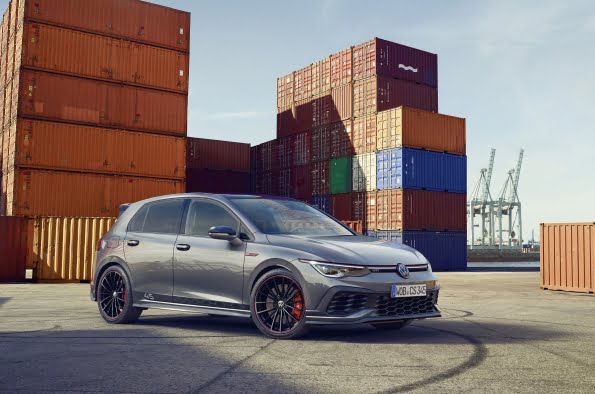
The recipe is simple, but effective – Volkswagen takes the Golf GTI Clubsport, with its 5.6-second sprint to 62 mph, 300 PS and 400 Nm of torque, removes the speed limiter to facilitate a top speed of 166 mph (where permitted), and adds an Akrapovič titanium sports exhaust system to augment the car’s engine note, save weight and improve exhaust flow. The already sporty aesthetic of the GTI Clubsport is given additional assertiveness with a set of dynamic 19-inch ‘Scottsdale’ alloy wheels, which feature a high-gloss black finish and a Tornado Red pinstripe around the rim. The car’s special status is further marked out by ‘45’ lettering on the side sill panels, and a metallic black finish to the door mirror covers and upper part of the spoiler.
Inside, GTI lettering appears on the backrests of the front sports seats, while the ‘45’ emblem features in the centre spoke of the steering wheel – a constant reminder to the driver that they are driving a part of hot hatchback history. Artvelours fabric in the door panels and a leatherette arm support add further sporting luxury to the interior of the model.
These tweaks combine to create the latest in a six-generation string of subtly tweaked but historically prominent special edition Golf GTI anniversary models, which started with the Golf GTI Mk III 20th Anniversary Edition in 1996, and continued every five years covering the Mk IV, Mk V and Mk VI Golfs in 2001, 2006 and 2011 respectively. For the Golf Mk VII, the model gained special, limited-edition Golf GTI Clubsport and Clubsport S variants for the GTI’s 40th anniversary.
Performance for this new special edition remains the same as that of the acclaimed GTI Clubsport – outputs of 300 PS and 400 Nm of torque translate into acceleration to 62 mph from standstill of 5.6 seconds. The Clubsport 45 achieves fuel economy of 37.7 mpg on the combined WLTP test cycle, with CO2 emissions of 169 g/km.
In addition to stellar performance, the Clubsport 45 retains all of the built-in agility of the Clubsport, thanks to the model’s Vehicle Dynamics Manager working in combination with electronically controlled running gear, including an electromechanical front-axle locking differential and XDS electronic differential lock. This eliminates the understeer often associated with front-wheel drive cars. This is complemented by a larger braking system, and can be further optimised with the addition of the optional Dynamic Chassis Control (DCC) adaptive damper system.
The Golf GTI Clubsport 45, as the pinnacle of the Golf GTI range, also has a wealth of equipment included as standard, in addition to its assertive looks, entertaining drive, impressive performance and illustrious history. The model comes equipped with such highlights as Volkswagen’s acclaimed Digital Cockpit Pro – a 10.25-inch, high resolution TFT dash display screen with customisable menus and information; IQ.Light LED Matrix headlights with different modes for diverse driving conditions and situations; Travel Assist, facilitating Level 2 semi-automated driving at speeds of up to 130 mph (where legal); the Car2X vehicle communication system, which communicates with other Car2X-equipped vehicles nearby for advance warning of hazards and other road obstacles; and the GTI Clubsport’s uniquely styled bumpers and performance rear spoiler, which in addition to their aesthetic benefits, improve aerodynamics and downforce of the car to sharpen the model’s already dynamic drive. For a comprehensive overview of the GTI Clubsport’s extensive equipment, details can be found in the Golf price list via volkswagen.co.uk.
Lisa Hartley, Golf Product Manager at Volkswagen UK, said: “The Golf GTI Clubsport 45 celebrates 45 years of the Golf GTI in style. It’s the latest in a long line of GTI anniversary special editions, and offers a greater level of dynamic engagement and agility than ever before.
“The Clubsport 45 is a piece of Volkswagen heritage in motion – the latest chapter in the ongoing Golf GTI story, 45 years –and counting – in the making. It is no exaggeration to call the GTI an automotive icon.”
Golf GTI range – including the new GTI Clubsport 45
Shift-by-wire: signals from compact DSG switch relayed electronically in the Multivan
Multivan DNA: every Bulli must offer that practical gap between the front seats for climbing through to the back
Automatically better: the next Multivan is equipped as standard with a dual clutch gearbox (DSG)
Sometimes even something really good needs to be reinvented to make it even better.
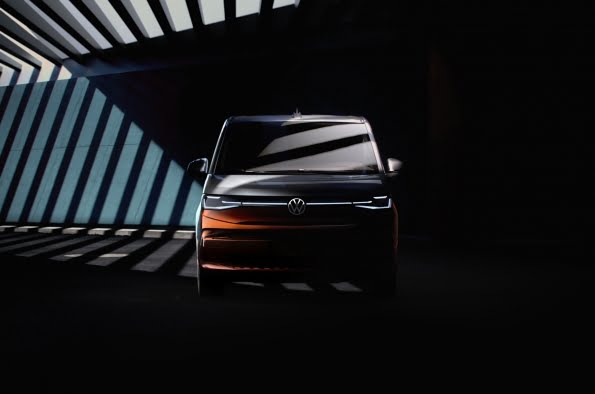
Volkswagen Commercial Vehicles has done that and simply dispensed with the gear knob. In the Multivan. The objective: to make driving easier and to increase space. Generation one and two of this best-selling vehicle – the T3 and T4 – were equipped with a conventional gear lever with a long shaft. In the third and fourth generation of the Multivan – the T5 and T6 – the means of changing gear then moved to the instrument panel. That optimised the gap through to the back, a typical feature in the Bulli. However, it can be even better, as a new Multivan will soon show.
The interplay of electronics and software is making new functions possible. In the next generation Multivan, Volkswagen Commercial Vehicles utilises this interplay to transform the gear knob into a switch and thus to reduce it in size so that the gap for climbing through to the back becomes even bigger. The technology behind it: shift-by-wire. That means electronic relaying of the gear change signals. With one click. The prerequisite for this is the fact that in future the Multivan is being equipped with a dual clutch gearbox, aka a DSG. That’s because where there is no longer a manual gearbox, space for a manual gear change mechanism, gear knob included, is no longer needed.
The Head of Design at Volkwagen Commercial Vehicles, Albert Kirzinger, explains in a short video (http://www.vwn-presse.de/vwn-presse/landingpages/Der%20neue%20Multivan/LAY_Teaser_Schaltung_EN.mp4) what also makes the Bulli a Bulli in the interior: “Generosity in the interior. We have taken out the gear knob. We’ve even cleared the space in the middle, assigned it to the driver. The new Bulli will be an exciting product. You can look forward to it.”
Instead, a small switch is now sufficient. It is integrated ergonomically perfectly into the new instrument panel to the right of the steering wheel. The DSG switch is thus on a level with the 10-inch display of the infotainment system – on which, for the first time in the Multivan, a real 360-degree representation of the vehicle is also displayed as an ‘Area View’ (optional) in order to make parking and manoeuvring very easy. One floor lower, meanwhile, the conventional handbrake lever has also been cleared out of the way. From now on, the parking brake is activated electronically by button or automatically. And thus the space between driver’s seat and front passenger seat increases even more. So that you can quickly jump into the back to see to the children during a stop. Or to get something from the cool box. Or to use the new multi-function table from the back as a centre console between driver’s and front passenger seat. But that is already moving on to another story about the new Multivan. To be continued.
Volkswagen Commercial Vehicles: We Transport Success, Freedom and Future As a leading manufacturer of light commercial vehicles, the Volkswagen Commercial Vehicles brand (VWCV) is reshaping the transportation of goods, services and people in a fundamental and lasting way. Our vehicles transport construction workers, families and adventurers, bread rolls, parcels and surfboards. Every day they help countless people all over the world to do a good job, they operate as mobile workshops and they bring paramedics and police personnel to wherever they are needed. At our sites in Hannover (D), Poznań (PL), Września (PL) and Pacheco (ARG), around 24,000 employees produce the Transporter, Caddy, Crafter and AmarokNutzfahrzeuge 3 model lines, and, as of 2022, will be producing the ID. BUZZ – the fully electric version of our iconic Bulli. Within the Volkswagen Group, VWCV is also the lead brand for autonomous driving and for mobility offerings such as Mobility-as-aService and Transport-as-a-Service – areas in which we are shaping the future of mobility.
In this way, the brand is transporting the society of tomorrow with all its requirements for clean, intelligent and sustainable mobility. It is this that Volkswagen Commercial Vehicles stands for with its brand promise: We transport success, freedom and future.
About the Volkswagen Commercial Vehicles brand: ‘We transport success’. As a stand-alone brand within the Volkswagen Group, Volkswagen Commercial Vehicles (VWCV) is responsible for the development, construction and sales of light commercial vehicles. They include the Transporter, Caddy and Amarok ranges, which are produced in Hannover (D), Poznań (PL), Września (PL) and Pacheco (ARG). Our vehicles transport construction workers, families and adventurers, bread rolls, parcels and surfboards. Every day they help countless people all over the world to do a good job, they operate as mobile workshops and they bring paramedics and the police to wherever they are needed. Within the Volkswagen Group, Volkswagen Commercial Vehicles is also the lead brand for Autonomous Driving, Mobility as a Service (MaaS) and Transport as a Service (TaaS), and in future will therefore be developing and producing corresponding Special Purpose Vehicles (SPV), such as robo-taxis and robo-vans. In this way we are transporting an entire society, with all its requirements for clean, intelligent and sustainable mobility. Working at the company’s sites around the globe are more than 24,000 employees, including around 15,000 at the Hannover site.
Why car manufacturers are keeping tabs on customers
The information car manufacturers gather from you
How manufacturers use the information
Do you know what your car’s logging, and are you okay with that?
New research by Parkers.co.uk, has revealed that although many new cars come with data-logging capability, 75% of drivers don’t want these systems in their cars, especially if they could affect things like insurance premiums.
The research from Parkers.co.uk comes off the back of an investigation into car companies’ use of behaviour data. This revealed that car companies share anonymised behavioural data about its customers, like where they go and their driving style, with third party data companies.
Just 10% of people polled knew their car had a data agreement in place already, and of them, only 19% of those people confessed to reading it. In addition, a whopping 86% of people would not be happy for their car to share driving habit data with third-party companies.
What we’re calling for is to make it easier for drivers to opt out of data agreements, and for it to be more obvious in the first place that your car is collecting this information in the first place – and why.
WHAT IS A DATA AGREEMENT?
Broadly it means agreeing to how and where your data can be shared. If you use Google you’ll have signed one before.
New cars with connected services (an internet connection or an app) will have you sign up for agreement. Generally, it involves agreeing to share data about you and the car with the manufacturer, and certain third-party companies.
WHAT DATA DOES YOUR CAR COLLECT?
This depends on what car you have, as well as how old the car is. If you can operate functions on your car (like the locks or the heating) via an app on your phone, or the car has an inbuilt sat-nav it can most likely collect data on you.
Common data collection from cars include:
Location information – like where you’ve been
Driver behaviour data – such as how hard you brake
Personal information – for instance, when you purchased your car
Marketing information – for example, when your PCP agreement is due to end
WHAT DOES THE FUTURE HOLD?
A few car makers have add-ons you can buy from inside of the car. Expect this to become the norm in the future. For instance, Skoda Octavia SE customers have the option of upgrading to auto-dip headlights for a one-off payment of £179. This includes unlimited access to the feature and is transferable from owner to owner. The software and hardware are installed into the vehicle, including the buttons needed to operate it, but it requires a further payment from inside the car to work.
Buying from behind the wheel looks set to become even more lucrative with autonomous cars. The Polestar 2 was the first car to have Google’s Android OS natively plumbed into it. Polestar’s website mentions that thanks to Android Automotive OS being native, the Polestar 2 ‘will soon be a shop you can buy things in.’
Mark Aryaeenia, CEO of vehicle data company, Verex, told Parkers: ‘Car companies are thinking far ahead into the future. For instance, an autonomous car has a captive audience. Imagine the e-commerce opportunities it has.’
WHAT DOES THIS MEAN FOR YOU?
A high percentage of people don’t want their data being collected. But a low number of people understand what data is being collected. The research from Parkers shows that regular car buyers don’t like the idea of car manufacturers profiteering from their untapped behavioural data, and that they don’t like being kept tabs on.
It also shows that car manufacturers can share data because people agree to their data being shared – but 81% of people haven’t read the user agreements they sign up to.
Parkers.co.uk editor, Keith Adams, says: ‘it’s true that we’re agreeing to all manner of terms and conditions daily – I shudder to think what Google knows about me – but it comes as a surprise to see so few drivers are aware of what their cars knows about them. It suggests that carmakers need to make their data gathering more transparent, their agreements easier to read for the 75% of drivers who currently don’t want it.’
WHAT WE’D LIKE TO SEE
While there’s undoubtedly a benefit to the driver in having all this data gathered, the fact that so few people are aware of this is concerning. Keith Adams added: ‘It’s a worry that only 19% of owners who know about their car’s data agreement have read them – we think it’s time that carmakers made these messages simpler and more prominent, and made opting out of this data capture process a simple click or press of a button.’