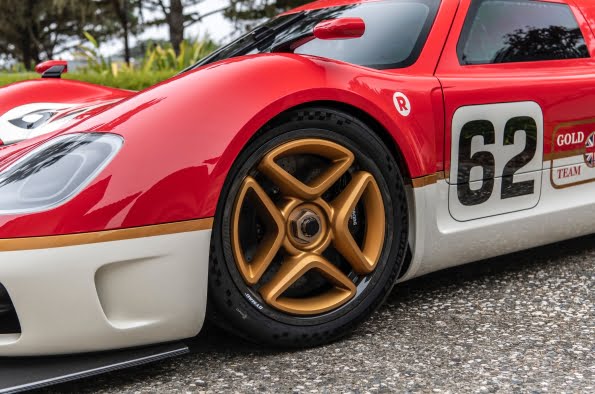
Gold Leaf Lotus Type 62-2 coachbuilt by Radford: public debut
Engineered using Lotus technologies to be a true driver’s car with the luxury appointments of a bespoke coachbuilder
Ultra-exclusive – just 12 of the limited build of 62 cars will be Gold Leaf liveried cars
Complete Gold Leaf liveried exterior design revealed, with coachbuilt additions inspired by the Lotus Type 62’s design purity – a coachbuilt homage to a beautiful 1960s race car
Gold Leaf livery and coachbuilt modifications provide increased visual drama – every Type 62-2 will be unique and bespoke built to precise customer requirements
Intoxicating power delivery from the 500bhp 3.5-litre supercharged V6 engine – alternative powertrain outputs are available
Over half of the 62 cars that will be built are already allocated to owners
Radford recently revitalised by preeminent designer Mark Stubbs, broadcaster and motoring specialist Ant Anstead, FIA Formula OneTM World Champion Jenson Button and leading business adviser and lawyer Roger Behle
Radford unveiled its Type 62-2 sportscar the public for the first time, in its Gold Leaf livery at the exclusive Quail Lodge show.
The Lotus Type 62-2 coachbuilt by Radford (The Type 62-2), is limited to just 62 examples worldwide, with each model built precisely to its individual owner’s desired specification. Of those 62 cars, only 12 will be Gold liveried cars, and Radford is now taking build slot applications for this ultra-exclusive model – and over half of the cars have already been allocated to owners.
The Gold Leaf Type 62-2 ‘Quail Edition’ is the most extreme version of the Gold Leaf liveried car. It is the first time the car has been seen in public, and it sits alongside the ‘Classic’ version, which provides subtle design cues to the original Type 62 Lotus car.
The Gold Leaf Type 62-2 Quail Edition wears a modern twist on the iconic Gold Leaf livery, which is one of the most famous and significant racing car liveries ever to grace a Formula 1 car. Its legendary red, white and gold colour scheme was applied after Colin Chapman signed a huge deal with Gold Leaf, and is most well-known on the Type 49B raced Graham Hill raced during the 1968 season. The colour scheme also featured on the famous Lotus 72 F1 car raced by Emerson Fittipaldi and Jochen Rindt in the 1970 season.
The Gold Leaf Type 62-2 Quail Edition showcases several key enhancements over the Classic and Gold Leaf cars. The car features a bespoke carbon fibre composite front splitter and rear diffuser. It also features AP Monobloc calipers and fully carbon ceramic brake rotors. These are housed within larger 18-inch front and 19-inch Dymag carbon composite wheels – which lower the unsprung mass, and improve the nimble handling characteristics of the car, yet further. The composite wheels are shod in Michelin Pilot Sport Cup 2 tyres.
Mark Stubbs “The Radford Type 62-2 in Gold Leaf guise, is a really special car. From a design perspective, the Gold Leaf car with these bespoke additions really stands out, with larger diffusers, and wheels. And sporting one of the most iconic racing liveries ever to grace a Formula 1 car, gives the car a real presence and sense of occasion. We’re only making 12 of these iconic cars, meaning they are already one of the rarest cars that money can buy. And most of them are already allocated to their owners.”
The design of the Gold Leaf Quail Edition is a demonstration of Radford’s modern coachbuilding capabilities. In every area of the bodywork the car is more extreme than the standard Gold Leaf car. At the front, the splitter is more pronounced, providing a race car stance, while at the rear, the diffuser is again more extreme, extending further out for increased aerodynamic downforce.
Ant Anstead “The Gold Leaf Type 62-2 that we’re showing at Quail is at the more extreme end of Type 62-2s that money can buy. It is low, sleek and powerful and sports one of the most iconic racing liveries ever created – one of the liveries that the heroes of Formula 1 such as Emerson Fittipaldi and Graham Hill used to race with, in the cars that started my passion for cars.”
“The Gold Leaf Type 62-2 is light, fast and nimble and will hold its own among even the most accomplished of supercars. Naturally, it is also embellished with all of the high-end touches you would expect of a bespoke coachbuilder such as Radford.”
Radford is inspired by the legendary British coachbuilding company of the same name, which once built cars for a celebrity clientele that included all four of The Beatles. The global company with British heart and soul is co-owned by leading designer Mark Stubbs, broadcaster and motoring specialist Ant Anstead, former FIA Formula OneTM World Champion, Jenson Button and acclaimed business adviser and lawyer Roger Behle.
Radford’s first new model of the modern era is built in a partnership with Lotus. While the mid-engine two-seater coupé takes inspiration from the revered 1960’s Lotus Type 62, it utilises the Hethel marque’s latest technologies to deliver the purest possible driving experience. The Radford Type 62-2 is engineered for an unadulterated mechanical feel, exceptional engagement and uncompromising poise.
The public premiere of the Gold Leaf car at the Quail is the first time the elegant lines of this ultra-exclusive version of the Type 62-2 exterior have been shown, and the luxurious interior will be revealed at a future date. The car’s design has been led by preeminent automotive designer Mark Stubbs who has taken the project from a sketch to the production-ready car revealed today. Stubbs’ design for the Type 62-2 evokes the spirit of Lotus and the original Type 62 as a homage to the marque’s illustrious motorsport history. With support from Radford’s engineers, former FIA Formula OneTM World Champion Jenson Button has fine-honed the dynamic response of the Type 62-2 to ensure a superlative driving experience.
Production of the Radford Type 62-2 begins in late 2021, with first deliveries being made in 2022.
McLaren Automotive’s first series production high-performance hybrid supercar, the Artura, will be on display at the British Motor Show
Show appearance follows the Artura’s public dynamic debut earlier this summer
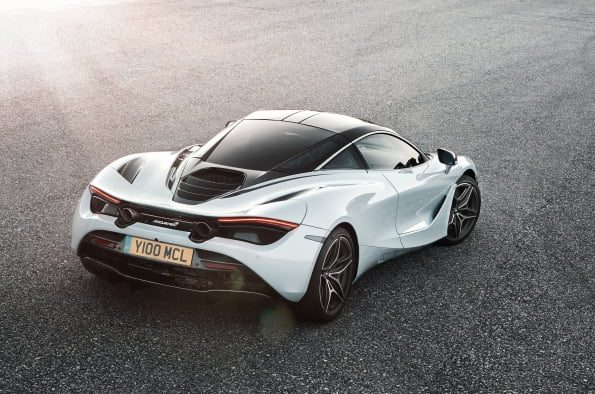
McLaren presence includes the GT and 720S – the latter in both Coupe and Spider form
McLaren Automotive will have a major presence at the British Motor Show, headlined by the all-new Artura – McLaren’s first series production high-performance hybrid supercar.
The show, which takes place from August 19-22, will be held at the Farnborough Exhibition Centre – a short distance from the McLaren Technology Centre in Woking.
Resplendent in Ember Orange, the Artura’s show appearance follows on from its public dynamic debut at the Goodwood Festival of Speed in July. The first car in its class to embrace electrification, the Artura remains true to the McLaren tradition of innovation in order to preserve its character as a lightweight supercar, despite the addition of an electrified drivetrain. Evolving technology first developed for the Ultimate Series P1TM and Speedtail hybrid hypercars, the plug-in hybrid Artura delivers scintillating performance and handling, while also being capable of low emissions and up to 30km* of near-silent running in electric-only mode.
Priced from £185,500, the Artura debuts a lightweight carbon fibre-based architecture – built at the McLaren Composites Technology Centre in the Sheffield region – and an all-new powertrain. This incorporates an all-new 120°-angle twin-turbo 3.0 litre V6, assisted by a compact 94bhp axial-flux E-motor. Combined output of 680PSand 720Nm and a DIN weight of 1,498kg enables blistering acceleration of 0-100km/h in 3.0 seconds; 0-200km/h in 8.3 seconds; and 0-300km/h in 21.5 seconds.
Joining the Artura at the show will be the full range of McLaren series production cars, including the 720S in both Coupe and Spider form. Appearing in Storm Grey, the 720S remains the benchmark supercar, with a twin turbo 4.0 litre V8 engine generating 720PS and carbon fibre chassis with Proactive Chassis Control II suspension and active aerodynamics to deliver class-leading ride and handling on both road and track. The 720S Spider – presented in Papaya Spark – adds a one-piece retractable hard top that opens and closes in just 11 seconds yet is less than 50kg heavier than the coupe and with equally capable chassis dynamics.
Also on display at the British Motor Show will be a McLaren GT finished in Serpentine, which combines the McLaren driving experience with everyday usability from its sleek and subtle styling and generous 570-litre luggage capacity to its cosseting interior trimmed with luxurious materials, hidden-until-lit features and Bowers & Wilkins audio system.
Visitors to the McLaren stand at the British Motor Show will be able to see these stunning cars close-up, with representatives from McLaren Ascot on hand to support with further enquiries including follow-up test drives, while fans will also be able to purchase merchandise from the McLaren store.
“We are delighted to support the British Motor Show, located just a short drive from Woking, just as the new Artura heralds an exciting new chapter for McLaren. The Artura represents the full force of McLaren – not just our first ten years as a volume luxury supercar manufacturer, but six decades of innovation and success in high performance. It joins our acclaimed series production range alongside the 720S – the benchmark supercar – and the GT, our most accessible high-performance car yet.” Brett Soso, Managing Director – Europe, Middle East & Africa, McLaren Automotive
Six new Bentleys appear publically for the first time over the course of Monterey Car Week 2021
New Flying Spur Mulliner launched to customers and media
Bentley Mulliner Bacalar and Blower Continuation Series complete Mulliner showcase
Bentley’s new range of hybrids come together for the first time, with new Flying Spur Hybrid joining Bentayga Hybrid
Continental GT Speed Convertible also makes first appearance
100 customer test drives from the Home of Bentley in Monterey
More than 2,500 guests join Bentley over four days
Bentley made a hugely successful return to public events in the USA with six debuts at Monterey Car Week 2021.
A four-day exhibition of the company’s latest products and Beyond100 strategy was run entirely in accordance with CDC guidelines, keeping Bentley’s guests and staff COVID-safe throughout. All three of Bentley Mulliner’s stunning portfolios – Classic, Coachbuilt and Collections – came together for the first time, alongside a public debut of Bentley’s new hybrid range featuring both the new Flying Spur Hybrid and the Bentayga Hybrid.
The Home of Bentley in Monterey was once again the destination for more than 2,500 Bentley customers and aficionados over the course of the event, with 100 of them taking test drives in the latest products. The Home featured a different line-up of Bentleys every day, supported by a hand-crafted display detailing the company’s Beyond100 strategy – Bentley’s nine-year journey to become the world’s leading sustainable luxury mobility company. The display featured the biofuel-powered Continental GT3 Pikes Peak at its centre, surrounded by a selection of in-development sustainable materials and information on the brand’s path to complete carbon neutrality and climate positivity.
Another attraction was Bentley’s “Unifying Spur,” its body decorated with artwork created by designer Rich Morris to highlight Bentley’s new diversity and inclusion strategy that celebrates Bentley’s dedicated networks of colleagues and aims to increase diversity at management level to 30 per cent by 2025.
Christophe Georges, President and CEO of Bentley Americas, comments: “Returning to Monterey for the first time after rejoicing in our centenary at Pebble Beach in 2019 has been a fantastic experience. After the challenges of the pandemic we chose to celebrate our customers, alongside our thoroughly modern and diverse range of new models, and being able to see customers in-person after such a long time apart was a great experience for everyone. Monterey Car Week is always a highlight in our calendar, and was particularly special this year as Bentley continues to deliver the strongest results in the company’s history.”
Bacalar, Blower, a brace of Hybrids and the new Flying Spur Mulliner
The breadth of Bentley’s handcrafted model range was apparent in the cars on display this year.
The new Flying Spur Mulliner – the pinnacle of the Flying Spur range, and featuring unique Mulliner details – was unveiled at the Home of Bentley on Thursday evening. 22” Mulliner wheels with self-levelling centres, a unique “Double Diamond” front grille and satin silver mirror caps give the Flying Spur even greater elegance, and are matched in the cabin with a comprehensive suite of trim features and materials that elevate Bentley’s renowned handcraftsmanship to an even higher plane.
The Flying Spur Mulliner was joined by its Continental GT coupe and Convertible siblings to represent the Mulliner Collections portfolio, one of three arms of Bentley Mulliner. The Coachbuilt portfolio was demonstrated by the development prototype (“Car Zero”) of the Bacalar project, resplendent in new Scarab green paint and a retrimmed cabin, both specifically created for Monterey Car Week. With the first examples of 12 highly exclusive customer cars now in build in Mulliner’s workshop, the Bacalar was used for demonstration drives with some of its clients, and made a star appearance at The Quail, A Motorsports Gathering on Friday, 13 August. The Bacalar then took pride of place on the Concept Lawn for Sunday’s Pebble Beach Concours d’Elegance.
The final star attraction from Mulliner was the representative of the Classic portfolio, in the form of the engineering prototype of the Blower Continuation Series. Having completed a 6,000 mile development and durability programme, Blower Car Zero was run on the roads around the peninsula every day during Monterey Car Week, covering 350 miles without missing a beat. Customers, media and guests were treated to passenger rides in the world’s first pre-war continuation car, to both delight and surprise at the car’s breath-taking performance.
Alongside the Mulliner showcase were new cars from Bentley’s mainstream product range. Of particular note was the public debut of Bentley’s new hybrid range, with the new Flying Spur Hybrid taking its place alongside the Bentayga Hybrid. Two thirds of Bentley’s model range is now available with a Hybrid option, as part of the brand’s journey to electrification and a first BEV by 2025.
The Mulliner family, the Hybrid range, the Unifying Spur and the Continental GT Speed Convertible formed a stunning display to welcome guests to Saturday night’s Signature Party, held at The Beach & Tennis Club in Pebble Beach where hundreds of VIP guests enjoyed an evening of fine food and drink accompanied by live music. The party followed the previous night’s private dinner at Seal Rock Beach for 150 clients, which was supported – as was the Home of Bentley – by Bentley’s new brand partner, The Macallan. Providing the finest drams for Bentley across the event – but never at a time when guests were driving – The Macallan x Bentley partnership was brought to life by regional brand ambassador, Keiron Elliot, who led guests through tastings and explained the journey that the two partners will be going on together.
Bentley Motors will return to the Monterey peninsula for Car Week next year, from 15 August 2022.
Emotive design and lowest drag coefficient within class
Most spacious car within its segment and larger boot capacity (+ 50 l)
Efficient EVO-generation engines with a range of more than 900 km
The fourth-generation Fabia continues ŠKODA’s extraordinary success story of offering all you need and that little bit more.
This is the first Fabia to be based on Volkswagen Group’s modular MQB-A0 platform. It is the most spacious car within its segment and boasts further enhanced comfort features as well as a several new safety and assistance systems. Classic brand qualities such as excellent value for money, high functionality and a host of Simply Clever features, make this car the perfect entry-level model to the ŠKODA range.
Thomas Schäfer, ŠKODA AUTO CEO, said: “The new Fabia provides the perfect entry to our range. We have combined the well-known ŠKODA attributes – such as generous amounts of space, the highest levels of quality and safety, and excellent value for money – with an emotive design and the lowest drag coefficient (cd) within its class. I am convinced that this overall package will allow us to further strengthen our position in the entry-level segment and attract new customers to the brand.”
Martin Jahn, ŠKODA AUTO Board Member for Sales and Marketing, stated: “The launch of the latest-generation Fabia is a real highlight for us. We have listened very carefully to our customers and refined our new small car in every aspect. With its dynamic look and state-of-the-art infotainment systems, we are increasingly appealing to younger customers. To sum it up: the new Fabia has everything it takes to continue the model’s success story.”
Boasting well-balanced proportions, sharply detailed headlights and rear lights – featuring the latest LED technology – this latest generation car is more emotive than ever before.
Inside, the instrument panel with a free-standing central display and optional digital instrument cluster catch the eye. Infotainment and connectivity are state of the art. The S, SE Comfort, SE L and Colour Edition trim levels will be available in the UK from launch at the end of 2021. A sporty Monte Carlo variant will follow later. Five petrol engines from Volkswagen Group’s current EVO generation deliver power outputs ranging from 48 kW (65 PS) to 110 kW (150 PS). Four Simply Clever features make their ŠKODA debut in the Fabia.
Exterior: largest boot and best aerodynamics
At just under 4.11 m in length, the new Fabia is 11 cm longer than its predecessor
Largest boot within the segment at 380 litres (+50 litres compared to the predecessor)
Best-in-class drag coefficient (cd = 0.28)
Mladá Boleslav, 16 August 2021 – Showcasing an emotive design, new proportions and even more space, the Fabia has taken the next step in its evolution. The fourth generation exceeds the four-metre mark for the first time, offering an even more spacious interior. At the same time, the new Fabia continues the current ŠKODA design language and looks particularly dynamic with its athletic proportions, sculptural lines, and sharply drawn headlights and tail lights featuring LED technology. Sophisticated details, such as aerodynamically optimised wheels and actively adjustable cooling shutters in the front bumper’s lower air inlet, allow for a drag coefficient (cd) of 0.28, setting a new record in the small car segment.
Oliver Stefani, Head of ŠKODA Design, said: “Even in its fourth generation, the Fabia is a perfect everyday family car while being more emotive than ever before. It is a modern and elegant vehicle that looks both compact and dynamic. I’d like to thank my entire design team for creating such an amazing car.”
The latest Fabia’s significantly more emotive appearance is the result of new dynamic proportions, ŠKODA-typical crystalline features, such as the razor-sharp headlights and tail lights, as well as sculptural lines on the bonnet. Small details really add to the overall look. These include body lines on the front doors stylising the characteristic triangle of the Czech flag.
Bigger in every aspect: a more spacious interior This is the first ŠKODA Fabia to be based on Volkswagen Group’s modular MQB-A0 platform and it outperforms its predecessors in every aspect but with virtually no change in weight. It is 111 mm longer, now measuring 4,108 mm, also making it the first Fabia to exceed the four-metre mark. At 2,564 mm, its wheelbase has gained 94 mm, while the width of the fourth generation has increased by 48 mm to 1,780 mm. The greater exterior dimensions result in even more passenger space. ŠKODA has also increased the Fabia’s boot capacity by 50 l (to 380 l) – the predecessor’s was already the largest in the segment. With the rear seats folded down, the capacity rises to 1,190 l. There is a choice of nine body colours, including the new Phoenix Orange and Graphite Grey metallic paint finishes. As part of the Colour Concept, metallic Graphite Grey and pearl-effect Magic Black can also be chosen as contrasting paintwork for the roof, wing mirror caps and alloy wheels. The ŠKODA grille surround can also be ordered in Graphite Grey. A panoramic glass roof is another optional feature.
Headlights and tail lights using LED technology The front of the new Fabia is characterised by razor-sharp, narrow headlights which extend to a striking, hexagonal grille. Low beam, high beam, the indicators and daytime running lights feature LED technology as standard, while the optional full-LED headlights provide more light-intensive low beam and high beam, as well as cornering and adaptive light functions. The sharply drawn, crystalline tail lights are also available in a full-LED variant on request.
Best-in-class aerodynamics with drag coefficient (cd) of 0.28 The Fabia’s aerodynamics have predominantly been developed using what is known as CFD (Computational Fluid Dynamics) simulations. During the development phase of approximately three and a half years, the ŠKODA engineers computed more than 3,000 of these simulations. ŠKODA has set a new record in the small car segment by reducing the drag coefficient (cd) to 0.28 – the previous generation was 0.32.
Cooling shutters improve fuel consumption ŠKODA has installed cooling shutters in the front bumper’s lower air inlet – the first time this technology has been used in this vehicle segment. To improve aerodynamics, actively adjustable slats automatically close when there is little need for cooling. To allow for a high level of cooling or to accommodate short stops, the system opens the shutters so the maximum amount of air can flow in. To further reduce drag, a larger roof spoiler and side finlets optimise the airflow at the rear. At the front, the air is guided through vents in the bumper, known as Air Curtains, in a particularly aerodynamic manner close to the side of the body and the wheels. Twelve panels now cover a larger part of the underbody instead of three, especially in the areas that are crucial for aerodynamics, such as the engine bay and the axles.
Aerodynamically optimised wing mirrors and wheels The housings of the electrically adjustable and heated wing mirrors, which for the first time in the Fabia dim automatically on the driver’s side and fold electrically as an option, are smaller than in the predecessor. This improves the car’s aerodynamics, as do the Proxima and Procyon alloy wheels, which also make their Fabia debut and feature special, aerodynamically optimised plastic trims. The wheel options include 15-inch steel wheels, as well as seven different alloys ranging from 15 to 18 inches. The optional, burnished 18-inch Libra alloy wheels in black are the range-topping variant.
Torsion-resistant body due to the use of advanced high-strengthsteels The new ŠKODA Fabia boasts an extremely high level of torsional stiffness, which increases safety, improves handling and ensures exceptional durability. To achieve these results while keeping the weight virtually the same as its predecessor’s, ŠKODA has designed the MQB‑A0‑based body to the latest standards, using significantly more hot-formed and high-strength steel components than in the previous model. They are mainly used on the A and B pillars, the bulkhead and the transmission tunnel. The proportion of the three hardest steel types – advanced high-strength steels, ultra-high-strength steels and press-hardened steels – rose from 15% to 40%. Overall, nearly 80% of the new ŠKODA Fabia’s body is made up of high-strength steel components.
Interior: intuitive control and a fresh look
ŠKODA interior design concept with large central display, fresh colours and even more space
Fabia lettering on the sides of the instrument-cluster housing, and circular air vents
Optional comfort features (as seen in higher-tier vehicles), including a heated windscreen and steering wheel
Mladá Boleslav, 16 August 2021 – The new ŠKODA Fabia’s interior is more spacious and comes with additional comfort features, striking a perfect balance between emotiveness and ergonomics. In keeping with ŠKODA’s current interior design concept, its look is characterised by fresh colours and the free-standing infotainment display measuring up to 9.2 inches. Large circular air vents and the new Fabia lettering on the sides of the instrument-cluster housing add further visual design touches. Other options making their FABIA debut include a heated windscreen and heated steering wheel (features previously found in higher-tier vehicles). ŠKODA will offer four trim levels in the UK from market launch.
Kateřina Vránová, Head of Colour & Trim Design at ŠKODA, said: “We have also equipped the new Fabia with our current interior design concept featuring a free-standing central display and a symmetrical instrument panel. The lower part of the dashboard is upholstered in fabric and sports contrasting stitching, which creates a pleasant and homely feel. Coloured decorative features, specific ambient lighting and chrome applications add to the car’s character and fresh look. Horizontal lines emphasise the width of the interior, further enhancing the generous feeling of spaciousness.”
For the fourth-generation Fabia, which will be launched in the UK in S, SE Comfort, SE L and Colour Edition trim levels (Monte Carlo to follow), the ŠKODA interior designers have added new visual touches to the brand’s current interior design concept. Besides the symmetrical instrument panel and the line below the large, free-standing central display which reflects the contours of the ŠKODA grille, the large circular air vents on the right and left also stand out. On SE L, these feature a chrome trim, as do the restyled door handles, and the front section of the dashboard is upholstered in fabric with contrasting stitching. A brand-new feature is the large FABIA lettering on both sides of the instrument-cluster housing.
Comfort features as seen in higher-tier vehicles make their Fabia debut The Fabia can now be ordered with some comfort features that were previously reserved for higher-tier vehicles including a heated windscreen for an unobstructed view and increased safety in winter. This is the first Fabia that can be ordered with dual-zone Climatronic including additional air vents on the rear of the front centre armrest to keep passengers cool. When equipped with this optional air conditioning system, the centre console features two rotary knobs to allow the temperature to be regulated separately for both sides of the vehicle. All of the system’s functions are easy to operate via just eight buttons.
New colours and LED ambient lighting Grey contrasting stitching, as well as decorative features, bring new colour accents to the Fabia’s interior. The new LED ambient lighting (standard on SE L) allows the driver to illuminate the decorative trim on the dashboard in white or red. The centre console and front door handles can also be lit up; furthermore, the ambient lighting includes LED reading lights in the front and rear. The seats, which for the first time feature adjustable lumbar support, have grey fabric upholstery in the S and SE Comfort trim levels and sport additional grey contrasting stitching in the Fabia Colour Edition. In the SE L variant, the seat covers are two-tone in grey and black.
Plenty of space for passengers and storage compartments totalling over 100 l With a wheelbase that is 94 mm longer than its predecessor, the new Fabia offers even more space for its passengers, especially in the rear. At 2,564 mm, it even surpasses the wheelbase of the first-generation ŠKODA Octavia launched in 1996. There are 15 storage options in the new ŠKODA Fabia.
Engines: wide range of power outputs and lower fuel consumption
Low fuel consumption
Five MPI and TSI petrol engines provide power outputs ranging from 48 kW (65 PS) to 110 kW (150 PS)
Mladá Boleslav, 16 August 2021 – There is a choice of five advanced and efficient EVO‑generation petrol engines for this latest, mark IV Fabia. ŠKODA has not only increased the number of different engines available, but also the range of power outputs – from 48 kW (65 PS) to 110 kW (150 PS).
All engines offered for the new Fabia come from the EVO generation. They are even more economical than the predecessor units and fulfil the Euro 6d emissions standard. The new range‑topping engine is the 1.5 TSI with an output of 110 kW (150 PS) and a 7-speed DSG as standard. Up to a power output of 70 kW (95 PS), the Fabia comes with a 5-speed manual gearbox; for the 1.0 TSI producing 81 kW (110 PS), there is a choice between a 6-speed manual gearbox and a 7‑speed DSG.
MPI engines developed by ŠKODA AUTO are more powerful while requiring less fuel ŠKODA AUTO is responsible for the development of all MPI engines used by the Volkswagen Group brands. The Fabia’s three-cylinder MPI engines with a displacement of one litre come from the EVO generation and are 4 kW more powerful than the predecessor units while achieving reduced fuel consumption and lower emissions. These improvements were made possible by an optimised crankshaft assembly – pistons and piston rings included – which reduces friction losses. The water circuit around the cylinder head and engine block has been redesigned to achieve greater cooling efficiency for the cylinders, combustion chambers and integrated exhaust manifold. The MPI engines fitted in the new Fabia operate according to the Atkinson combustion cycle, in which the intake valves close only during the compression stroke of the piston. This drives some of the fuel mixture back into the intake manifold, which reduces the effective compression ratio while maintaining a high expansion ratio of 12:1. As a result, the engine consumes less fuel and is therefore more efficient.
Innovative plasma coating on 1.0 TSI engines The two direct-injection 1.0 TSI engines available for the new Fabia feature plasma-coated cylinder liners. The innovative, thin, powder-coated layer measures just 150 μm (0.15 mm) and replaces cast-iron cylinder liners, reducing internal friction in the three cylinders. This lowers fuel consumption and emissions. Through better distribution and dissipation of heat in the combustion chamber, it also lowers the thermal load on the engine. The engines operate in the fuel-efficient Miller cycle and with a high injection pressure of 350 bar. In the Miller cycle, the intake valves remain open for longer during the compression stroke, which reduces pumping loss and improves thermal efficiency. The turbocharger features variable turbine geometry, which produces more torque at a wider range of engine speeds and lower emissions.
Active cylinder technology for the new top-of-the-range 1.5 TSI engine The Fabia’s new top-end engine is the four-cylinder 1.5 TSI with a power output of 110 kW (150 PS). In addition to the plasma-coated cylinders and high injection pressure of 350 bar, it also features active cylinder technology (ACT). When engine load is low, this system automatically – and virtually without the driver noticing – shuts down two cylinders, thereby reducing fuel consumption and CO2 emissions.
Engines and transmissions developed and produced by ŠKODA AUTO in the Czech Republic Most of the engines and all of the gearboxes for the new ŠKODA Fabia are produced in the Czech Republic. The MPI engines and the 1.0 TSI are built at ŠKODA’s main plant in Mladá Boleslav, as are the manual transmissions. The 7-speed DSG comes from the ŠKODA plant in Vrchlabí. The TSI engines have a petrol particulate filter.
Engines available for the new ŠKODA Fabia at a glance:
Engine
Cylinders
Max. power output
Max. torque[Nm]
Transmission
Max. speed [km/h]
Acceleration0–100 km/h [s]
Combined consumption WLTP[litres/100 km]
CO2 emissions WLTP[g/km]
[kW]
[PS]
1.0 MPI EVO
3
48
65
93
5-speed M
172*
15.9*
5.0*
114–124*
1.0 MPI EVO
3
59
80
93
5-speed M
179
15.5
5.0
114–124
1.0 TSI EVO
3
70
95
175
5-speed M
195
10.6
5.0
113–126
1.0 TSI EVO
3
81
110
200
6-speed M
7-speed DSG
205
205
9.7
9.6
4.9
5.4
113 – 127
124 – 136
1.5 TSI EVO
4
110
150
250
7-speed DSG
225*
8.0*
5.6*
128–142*
* preliminary data
Safety: up to nine airbags and new assistance systems
Featuring up to nine airbags, the new Fabia is one of the safest small cars on the market
No fewer than seven assistance systems make their Fabia debut
ISOFIX anchors and top tether anchor points for optimal installation of child seats
Mladá Boleslav, 16 August 2021 – With up to nine airbags, the new ŠKODA Fabia is one of the safest vehicles in its segment. As a result of the Fabia now being built on the modular MQB-A0 platform, its active and passive safety features have been further improved, and it now includes assistance systems that were previously reserved exclusively for higher-tier vehicles. Travel Assist, Park Assist, Lane Assist, Traffic Sign Recognition, Side Assist, Front Assist with Predictive Pedestrian and Cyclist Protection, and Manoeuvre Assist are all available for the first time in the Fabia. In addition, the latest generation can now be equipped with up to nine airbags.
The new model is based on Volkswagen Group’s modular MQB-A0 and ŠKODA AUTO has fully exploited the possibilities this platform has to offer. It enabled advanced assistance systems from higher-tier vehicles to be used in the Fabia. Overall, seven systems which increase safety and comfort make their debut in the range.
Travel Assist includes several assistance systems The optional Travel Assist is a new addition to the range and incorporates several systems to provide automatic support with longitudinal and lateral steering; this feature can be activated at the touch of a button. Using Hands-on Detect, Travel Assist checks at regular intervals whether the driver is touching the steering wheel consistently. In addition to Adaptive Cruise Control (ACC), Travel Assist also includes Lane Assist and Traffic Sign Recognition – both of which make their Fabia debut. Side Assist, Front Assist with Predictive Pedestrian and Cyclist Protection, Park Assist and Manoeuvre Assist are also new to the range.
Now with up to nine airbags Driver and front passenger airbags, curtain airbags and front side airbags are fitted as standard in the new Fabia. A knee airbag for the driver and side airbags for the rear are optional. This increases the number of airbags protecting the car’s occupants in the event of an accident to nine. To safely secure child seats, ISOFIX anchors and top tether anchor points on the outer rear seats come as standard and are optional on the front passenger seat. This means that the FABIA can safely and conveniently accommodate seating for three children.
Connectivity: latest-generation infotainment systems are always online
Touchscreens measuring up to 9.2 inches, gesture control and digital voice assistant
Optional digital instrument cluster available for the first time in the ŠKODA Fabia
Always online with access to a wide range of mobile online services from ŠKODA Connect
Wireless smartphone integration
Mladá Boleslav, 16 August 2021 – An optional digital instrument cluster makes its debut in the range and infotainment systems feature permanent internet connection: in terms of connectivity, the new ŠKODA Fabia is state of the art. With a built-in eSIM, the Fabia is always online and enables access to web radio, extensive mobile online services from ŠKODA Connect and the latest infotainment apps. The largest touchscreen measures 9.2 inches, and the 10.25-inch digital instrument cluster offers five different display options. Amundsen, the range-topping system, can be operated by gesture control and via the Laura digital voice assistant.
The latest-generation Fabia can now be ordered with a digital instrument cluster – this is a first. The driver can configure the 10.25-inch digital display to suit their needs, choosing from up to four basic layouts. These include the Classic layout, which is based on the style of analogue round instruments, as well as the Modern, Reduced and Extended layouts. The digital instrument cluster – or ‘Virtual Cockpit’ – can display the map including a close-up of junctions, radio station logos, music album covers and caller profile photos, among other things. As standard, the Fabia comes with an analogue instrument panel and a 3.5-inch information screen.
A choice of three infotainment systems The launch of the new ŠKODA Fabia also sees the introduction of the third-generation infotainment systems to the range. There are three systems to choose from: the Swing radio with a 6.5-inch colour display, the Bolero radio with an 8-inch display and Bluetooth hands-free capability, and the top-end system Amundsen. The latter features a customisable 9.2-inch display, and a navigation function that is backed by online data and can be updated remotely. The gesture control feature comes as standard, while online-backed voice control via the Laura digital voice assistant – who understands 15 languages – is optional.
Wireless smartphone integration and mobile online services from ŠKODA Connect A smartphone can be connected without the need of a cable via Wireless SmartLink and Android Auto or Apple CarPlay, while the optional Wireless Charging enables inductive charging. For the first time, there are up to five USB-C sockets for charging further mobile devices – one of which can be found on the rear-view mirror to charge a dashcam, for example. Amundsen, the range-topping infotainment system, provides access to a host of ŠKODA Connect mobile online services. In addition to eCall, which automatically calls for emergency assistance in the event of an accident, these also include Proactive Service (breakdown call), and remote vehicle access via the MyŠKODA app and the ŠKODA Connect web portal. The customer can create a ŠKODA Connect account or transfer an existing account to the Fabia directly on the car’s display. It is just as easy to download infotainment apps that offer weather reports and news, provide access to a personal Google calendar, or warn of danger.
Simply Clever: four new features in the Fabia
New Simply Clever solutions keep the interior and boot tidy
A choice of 42 ŠKODA-typical ideas for the Fabia – more than ever before
Mladá Boleslav, 16 August 2021 – For many years, ŠKODA has made it easy for customers to use their vehicles on a daily basis by offering new and sophisticated Simply Clever solutions. The Czech carmaker is continuing this tradition by adding four all-new features to the range, and another eight make their Fabia debut in the fourth generation of this popular small car. Depending on the specification, the new ŠKODA Fabia offers up to 42 practical features that make everyday life that little bit easier – that’s more than ever before. In addition to ŠKODA classics – such as the ice scraper in the fuel filler flap with a tyre tread depth gauge and an umbrella in the driver’s door – the range now includes all-new clever details that make the interior and boot much tidier with very little effort.
Four Simply Clever solutions make their ŠKODA debut in the new Fabia. For example, a new clip for a credit card or car park ticket and an elastic band as a pen holder keep things tidy in the storage compartment in the centre console. A removable cup holder between the front seats offers the driver and front passenger more flexibility as an option. The box in the transmission tunnel is another option, providing rear passengers with a clever storage solution for small items. The box just needs to be placed between the centre console and the rear seats and then locks itself into place. A flexible storage compartment for the boot is another feature to choose from. This saves space by being located on the side wall, and can be pulled out to secure items if required. The fifth feature to premiere is the sun visor, available as an accessory for the optional panoramic roof. When not in use, this folds to a third of its size and can be stored under the boot cover.
USB-C socket on the rear-view mirror and a multifunction storage pocket for coats Some Simply Clever solutions as seen in other ŠKODA models are now also available for the Fabia. These include a USB-C socket on the rear-view mirror, which is available as an option for the SE L and Colour Edition trim levels. This can be used to power a dashcam, for example, without a dangling cable obstructing the driver’s view. Also new to the popular small car range, in addition to the folding backrest of the front passenger seat, is a multifunction storage pocket that attaches below the boot cover. This converts an otherwise mostly unused space into a perfect storage area for coats or jackets, and can accommodate items weighing up to 3.5 kg. The easy-to-reach smartphone storage pockets on the front seatbacks (as found in the Octavia and Enyaq iV) are also making their Fabia debut.
The new Simply Clever features available for the Fabia at a glance:
Two smartphone storage pockets on the front seatbacks
Multifunction storage pocket
USB-C socket on the rear-view mirror
Folding flexible storage compartment in the boot *
Reading light in the rear that can be operated from the front
Removable Easy Open cup holder *
Wireless Charging
Card and pen holder in the storage compartment in front of the gearstick *
Card and coin holder in the lid of the glove compartment
Storage compartment on the tunnel in front of the rear seats with a cup holder *
Removable sun visor for the panoramic roof *
Loading sill protection
* making their ŠKODA debut
Success story: Fabia deliveries exceed 4.5 million
The Fabia is the second most produced ŠKODA model after the Octavia
For 22 years, the series has been an important cornerstone of the ŠKODA model range
Germany, the Czech Republic, Poland and the UK are the largest sales markets
Mladá Boleslav, 16 August 2021 – Twenty-two years after the Fabia’s market launch, ŠKODA continues to build on the success of this popular small car with its fourth generation. After the Octavia, the Fabia is the second most produced ŠKODA model and an important cornerstone for the Czech car manufacturer. More than 4.5 million units of the hatchback variant and the Fabia Estate have been delivered to date. Almost 375,00 Fabias have found homes with UK customers since it was introduced in 2000.
Since its launch in 1999, the ŠKODA Fabia has been one of the bestselling vehicles in its class. It was a very appealing model from the outset, boasting generous amounts of space despite compact exterior dimensions, offering the highest levels of safety, functionality and efficiency, and representing excellent value for money. This successful formula made the ŠKODA entry-level model an attractive choice for a wide range of customers for more than two decades.
In approximately eight years, as many as 1.79 million first-generation Fabias, which were also available as an estate from 2000, were delivered. The second generation was unveiled at the 2007 Geneva Motor Show and had a total of 1,704,000 buyers. The third generation, presented in 2014, continued this momentum and, in 2019, was the second most delivered ŠKODA model after the OCTAVIA.
Overall deliveries of the Fabia exceed 4.5 million vehicles to date – a figure that is only surpassed in the ŠKODA range by the Octavia. The largest single market for the Fabia is Germany, with 18,070 deliveries in 2020, ahead of the Czech Republic (17,750), Poland (12,556) and the UK (9,771).
Limited edition Esprits star in collection of highly desirable Lotus models which are up for sale with online classic car auctioneer The Market
Among them is an instantly recognisable 1978 Esprit S2 ‘JPS’ edition and a sought-after 1981 Esprit Turbo Essex S3
Rarity and few previous owners add to the appeal of this stunning Lotus collection with the online auction starting on 23rd
Original online classic car auctioneer, The Market, has secured a collection of six highly-desirable and rare, limited-edition Lotus Esprits – instantly recognisable through their cult status – for sale.
Heading up the charge is a jaw-dropping 1978 Esprit S2 ‘JPS Edition’ sporting its unmistakable black and gold livery.
Guided at between £75,000 to £100,000, this head-turning model has a mere 13,600 miles on the clock, has had just four previous owners and is considered one of the best, low mileage examples of its type.
Not to be outdone is an unbelievably rare 1981 Esprit Turbo Essex S3, also complete with its own distinct paintwork, this time in iconic blue and red Essex petroleum colours.
With an excellent history file, an extensive restoration and just two previous keepers, this particular model is just one of 45 models ever built and is also complete with Panasonic roof mounted stereo and original 15” compomotive split rims. It is estimated at between £105,000 to £150,000.
Also with just two previous owners is a 1994 Esprit ‘Sport 300’ in stunning Camel Racing Yellow and complete with Blue Alcantara leather, Lotus Certificate of Provenance and original books. It is believed to be the first time a ‘Sport 300’ has ever been sold at auction which is reflected in the estimated hammer price of between £70,000 to £120,000.
Tristan Judge, director, The Market, said: “To have secured just one of these limited edition Lotus Esprits for sale would have been fantastic but to be able to offer all six from the same private collection is unbelievable.
“It is a great opportunity for aficionados of this iconic British marque to own the Lotus of their dreams.”
Among the other Esprit from the collection available to bid online for include a Championship Winners Limited Edition 1995 Esprit S4 GT, which pays homage to the Lotus single seaters and is expected to reach between £35,000 to £50,000. It stands apart with its metallic Lotus Brooklands Green livery and is just one of eleven built.
The final two Esprit from the collection include a stunning 1995 Esprit S4S, estimated at between £35,000 to £50,000 and an immaculate 1999 Esprit V8 350S with just three owners and with a guide price of between £55,000 to £70,000.
Tristan added: “This unique collection embodies the spirit of Lotus. Interest will be high and, who knows, such is the adoration could remain as a collection if all six are bought by a single enthusiast!”
Entering the final year of production, the 2022 Ford GT Heritage Edition supercar pays homage to the 1964 Ford GT prototypes that led to America’s only Le Mans®-winning supercar, with wins from 1966 to 1969, and again in 2016
Ford GT Heritage Edition is a modern interpretation of the original, combining classic Ford Performance features such as Wimbledon® White paint and a triple racing stripe with contemporary touches including exposed carbon fiber behind Antimatter Blue-painted carbon fiber wheels and Lightspeed Blue Alcantara® suede seats
Ford GT ’64 Prototype Heritage Edition debuts at Monterey Car Week alongside the sole surviving 1964 Ford GT prototype, chassis GT/105, in original livery at The Quail and on the concept lawn at the Pebble Beach Concours d’Elegance® this week
As a tribute to the Ford GT supercar, the prototype vehicle that gave life to the program more than a half-century ago, Ford is introducing the 2022 Ford GT ’64 Prototype Heritage Edition.
The limited-edition vehicle is inspired by the 1964 Ford GT prototype that debuted at the New York International Auto Show on April 3, 1964 and went on to become America’s only Le Mans-winning supercar.
“This is the first Ford GT Heritage Edition that goes beyond celebrating race wins – this one goes deep, and honors the earliest of Ford supercar heritage,” said Mike Severson, Ford GT program manager. “The Ford GT ’64 Prototype Heritage Edition is a modern interpretation of the original, with no mistaking what this car is paying tribute to.”
The Ford GT ’64 Prototype Heritage Edition is sharing the spotlight at Monterey Car Week, with the only remaining 1964 Ford GT prototype, GT/105, still wearing the original livery.
Limited-edition run honoring the five original GT prototypes The Ford GT ’64 Prototype Heritage Edition supercar wears Wimbledon White paint with Antimatter Blue graphics, including an over-the-roof triple racing stripe. Exposed carbon fiber components are prominent, including 20-inch Antimatter Blue-painted carbon fiber wheels, a touch unique to Ford GT, as well as an exposed carbon fiber front splitter, side sills, mirror stalks, engine louvers and rear diffuser finished in gloss. Brembo® brake calipers lacquered in silver with black graphics, plus black lug nuts further modernize the aesthetic.
Carbon fiber carries into the cabin as well, with carbon fiber door sills, lower A-pillars and console, along with matte carbon fiber registers. Lightspeed Blue Alcantara®-wrapped carbon fiber seats feature silver stitching, while seating surfaces and head restraints are embossed with the GT logo. The instrument panel is wrapped in Ebony leather and Lightspeed Blue Alcantara, while pillars and headliner are wrapped in Ebony Alcantara. Antimatter Blue appliqués on the instrument panel, door register bezels and seat X-brace are coordinated with the unique wheels. The steering wheel is finished in Ebony Alcantara with black stitching, while dual-clutch paddle shifters are clear and polished.
“There are a lot of milestone moments in the history of Ford GT that we’ve celebrated, but the team was unanimous in believing the original prototype was the right vehicle this time around,” Severson said. “That 1964 prototype unleashed the creative genius of the Ford Advanced Vehicles team and paved the way for the Ford GT program. It put all of this in motion.”
Original Ford GT prototypes underscore ingenuity and speed With the objective of beating Ferrari® and winning Le Mans, Ford began development of its own race car in 1963, and less than a year later, the Ford GT prototype (chassis GT/101) was revealed at the 1964 New York International Auto Show.
Five GT prototypes were built – the first Ford models to use deep aerodynamic analysis to optimize high-speed performance. These are some of the most significant cars produced by Ford, marking the foundation for the GT program that culminated in the company’s 1-2-3 sweep at Le Mans in 1966. The cars symbolize the groundbreaking engineering that continues at Ford with the 2022 Ford GT Heritage Edition.
Of the five Ford GT prototypes built, chassis GT/105 is the only one to survive and wear the period-correct livery.
Chassis GT/101 and GT/102 were scrapped after Le Mans and Monza crash testing, but that testing was critical in making significant improvements to GT/103, GT/104 and GT/105. Marking the first GT victory, GT/103 won at Daytona® in 1965 with Ken Miles and Lloyd Ruby behind the wheel, while GT/104 placed third with Bob Bondurant and Ritchie Ginther. Both GT/103 and GT/104 have been repainted and are exclusive displays at the Shelby® Museum in Boulder, Colorado.
Building on the Heritage Edition series The Ford GT Heritage Edition series has celebrated landmark moments, and of course Le Mans-winning titles. To date, the new 2022 Ford GT ’64 Heritage Edition marks the sixth in the ultra-limited-production series. These include:
2021 Ford GT ’66 Daytona Heritage Edition
Honoring the Ford GT MK II No. 98 race car
In production
2020 Ford GT ’69 Gulf Livery Heritage Edition
Honoring the Ford GT40 MK I 6 race car that was victorious at 1969 Le Mans
Only 50 built
2019 Ford GT ’68 Gulf Livery Heritage Edition
Honoring Ford GT40 MK I 9 race car that was victorious at 1968 Le Mans
Only 50 built
2018 Ford GT ’67 Heritage Edition
Honoring Ford GT40 MK IV No. 1 race car that was victorious at Le Mans in 1967
Only 39 built
2017 Ford GT ’66 Heritage Edition
Honoring Ford GT40 MK II No. 2 that Bruce McLaren and Chris Amon drove at 1966 Le Mans
Only 27 built
2006 Ford GT Gulf Livery Heritage Edition
Commemorating GT40’s back-to-back 24 Hours of Le Mans titles in 1968 and 1969
Only 343 built
The 2022 Ford GT is available to order for approved Ford GT customers. Production is scheduled to begin in January. Click here for more information.