by gaukcars.com | Oct 1, 2024 | Blog
- Assembly of the rally cars has begun
- Audi RS Q e-tron with complex powertrain concept
- Four kilometers of cables, two central control units and six cooling systems
In 100 days from now, the 44th edition of the famous Dakar Rally will kick off. For Audi Sport, this marks the beginning of a real race against time.
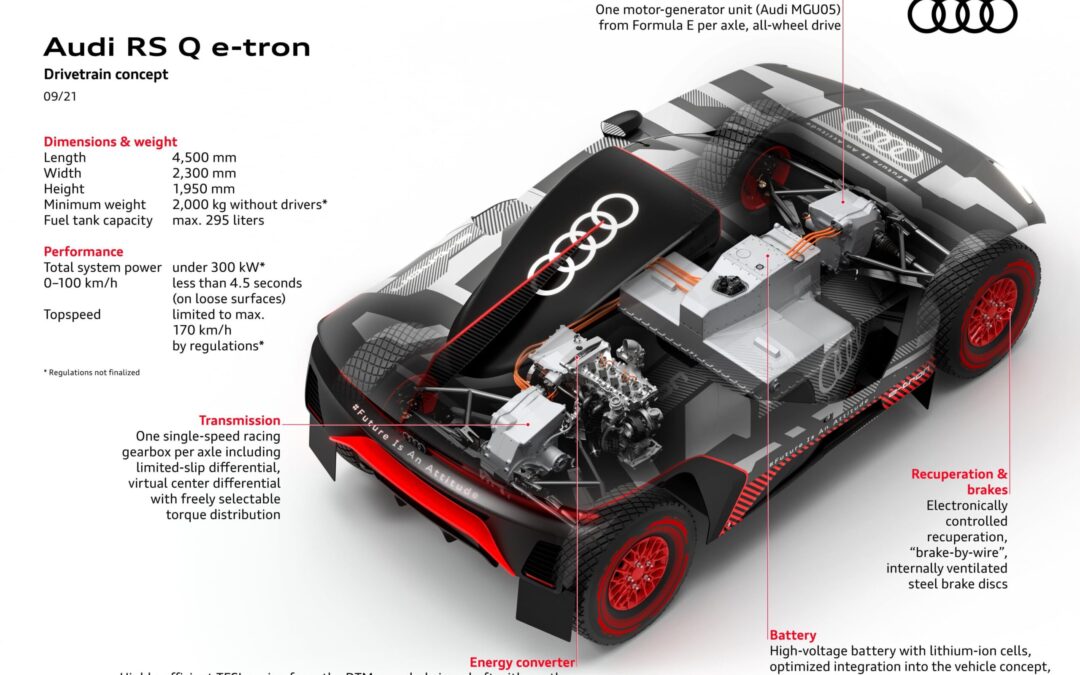
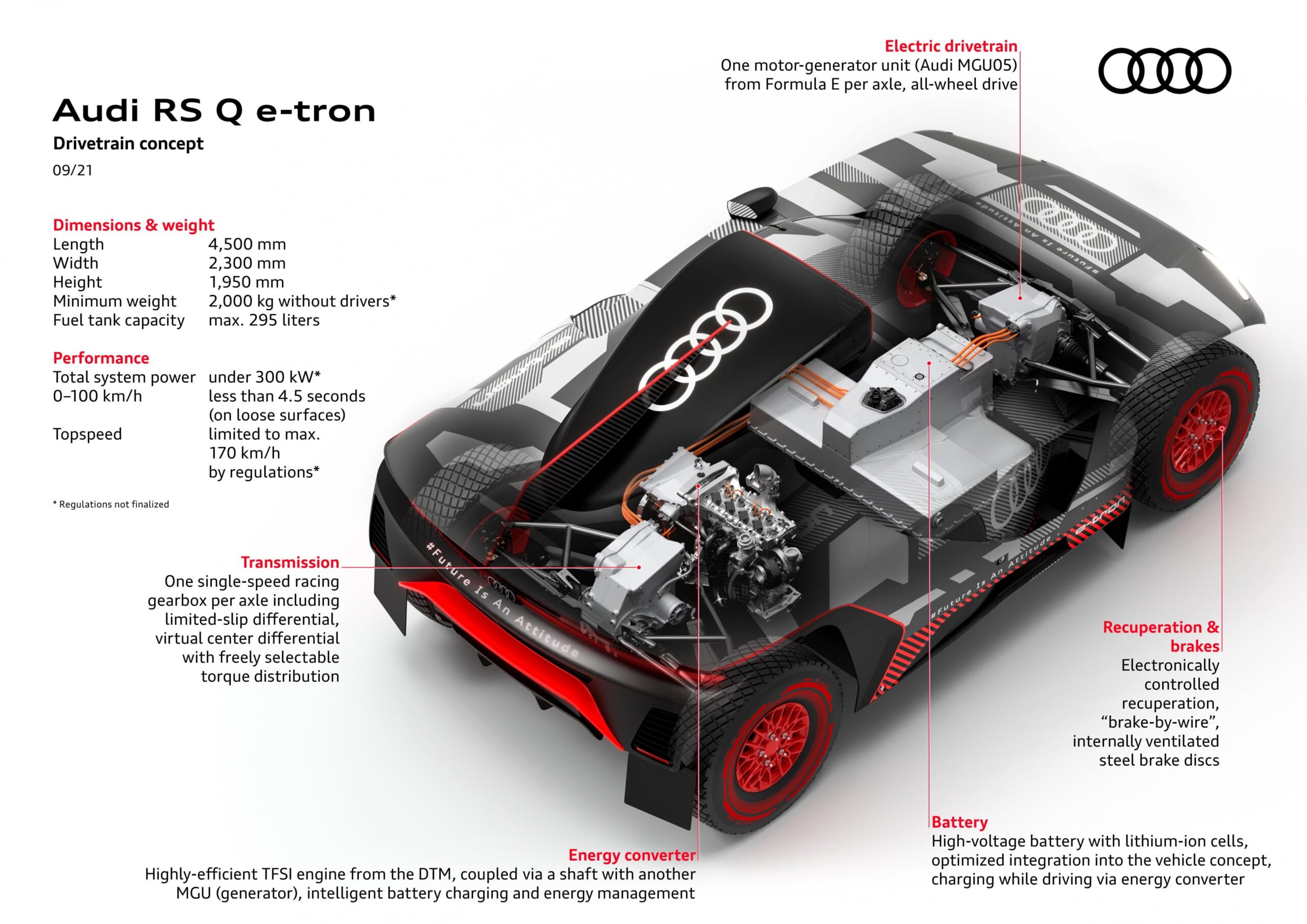
Audi is tackling one of the greatest challenges in international motorsport, quite deliberately using a unique concept. The Audi RS Q e-tron has an electric powertrain with two motor-generator units (MGUs) from Formula E. While the vehicle is in motion, the high-voltage battery is charged by an energy converter consisting of the efficient TFSI engine from the DTM and another MGU.
“The prototype of the Audi RS Q e-tron was created in around twelve months,” says Julius Seebach, Managing Director of Audi Sport GmbH and responsible for motorsport at Audi. The rollout on June 30th, 2021 in Neuburg an der Donau and the start on January 1, 2022 in Ha’il (Saudi Arabia) are separated by merely six months. “That’s a very short time to prepare for such a complex project. I cannot emphasize this often enough: The Audi RS Q-e-tron is the most sophisticated vehicle in terms of technology that Audi Sport has ever deployed in racing.”
Andreas Roos, Project Leader for all factory-backed motorsport activities, can only confirm that: “The Dakar is extremely challenging – even for a conventionally powered vehicle. With our powertrain concept, the challenge is distinctly greater. The chassis and suspension do not entail major differences, but we have a lot more components in the car that have to be not only high-performing, lightweight and functioning reliably under the extreme conditions of the Dakar. They also have to be attuned to each other perfectly and work together smoothly.”
A conventionally powered Dakar vehicle features two major components: the internal combustion engine and the transmission. “In our Audi RS Q e-tron, we have an electric motor at the front axle, an electric motor at the rear axle, the high-voltage battery and the energy converter, consisting of another MGU and the TFSI engine from the DTM,” says Roos. “And each of these components, for instance, requires a dedicated cooling system. That means we have not only one cooling system in the car but as many as six, including the intercooler and air conditioning system for the driver and co-driver.”
Packaging is another major issue with such a complex vehicle. “We had to make use of every centimetre to accommodate all the components in the car,” says Roos. That comes at the cost of ease of service. “For instance, changing the front-axle differential still takes a lot of time at the moment. That must be achievable faster at the Dakar and is one of the issues we’re currently working on under massive time pressure.”
Obviously, the special conditions at the Dakar Rally play a role as well: sand, water, cold and major elevation differences. “We have a really large amount of sensitive electronics and many electrical components in the car that we need to protect against sand and water as effectively as possible,” says Roos. “We’ve learned a lot in the tests we’ve run so far and are now trying to feed all of our findings into the rally cars in time for the Dakar Rally.”
A large part of the work is in the areas of software, electrical and electronic systems. “We’ve got two central control units and around four kilometres of cables in the vehicle – not even counting the high-voltage cables,” says Roos. “The interaction of all powertrain components and of the high-voltage battery as well is extremely complicated. If anything doesn’t fit there the car will stop.”
Meanwhile, assembly of the race cars for the Dakar Rally has begun at Audi Sport in Neuburg an der Donau. Because the Audi RS Q e-tron travels also on public roads in cross-country competitions, each vehicle receives road approval including the related individual acceptance. Concurrently, the development schedule up until December includes a large number of additional stations – such as the Audi climate chamber for simulating the temperatures and elevation differences prevailing at the Dakar and a pendulum test on a speciality test rig.
There are still 100 days remaining before the Dakar Rally kicks off. 100 days that will become extremely intense for everyone in the Dakar team to achieve the next major stage goal: to put three superbly prepared cars on the starting ramp in Ha’il.
In 2020, a challenging year marked globally by restrictions due to the coronavirus pandemic, Audi delivered a total of 1,692,773 models, a fall of 8.3 percent compared with the previous year. The contribution by Audi UK to this total remained significant at 107,892 cars. Audi is already making considerable headway with its range-wide electrification programme, which began with the world premiere of the all-electric Audi e-tron SUV in September 2018, and is now the biggest manufacturer of electric vehicles among the three German premium brands. Due for introduction during 2021 are the new e-tron S, e-tron S Sportback, Q4 e-tron and e-tron GT sports car variants. By 2025, Audi will offer more than 20 models with all-electric drive in the most important markets worldwide and achieve roughly 40 per cent of its sales with electrified variants. These will of course be underpinned by a range of models with classic layouts covering every relevant market segment from the compact class to the luxury class.
by gaukcars.com | Oct 1, 2024 | Blog
- SAIC Design Advanced London reveals new R RYZR concept study
- R RYZR combines urban mobility and wearable technology
- Revealed as design studio celebrates three-year milestone
- Global design base for ROEWE, ‘R’ and MG brands
SAIC DESIGN has revealed a vision of future mobility that explores the boundaries between urban mobility and wearable technology.
A fusion between a car and a motorbike, the R RYZR – developed for SAIC’s EV-only ‘R’ brand – is the ultimate symbiosis of man and machine: a car that you actually wear. It features a jacket and a vehicle that interlock to start it, with no need for a key.
Designed to recognise the shift away from crowded public transport and the need for more instinctive experiences, it offers an escape from crowded spaces by combining cutting-edge technical apparel and augmented reality.
It also shares the brand philosophy of ‘R’ – that of effortless power.
“R RYZR is an exciting and visceral vision of the future of urban travel,” said Carl Gotham. “by exploring the unconventional, it unlocks new modes of transports for the future, new experiences and new emotions.”
The concept is designed to achieve the ultimate ease of use – motorcycle agility with car-like stability, while the RYZR clothing concept means no need for an app or a key – the vehicle simply recognises the owner’s jacket instead.
“R RYZR is a useful, agile, practical, and exciting form of urban transport,” added Carl Gotham. “It combines the aesthetic of cutting-edge technical apparel and augmented reality with futurism. It’s an exploration of unconventional mode of transports for the future – new architectures, new experiences and new emotions.”
by gaukcars.com | Oct 1, 2024 | Blog
- 20-Ghost Club re-enacts historic London-Edinburgh Trial of 1911 with the winning Silver Ghost, chassis number 1701
- Starting from the Royal Automobile Club, Pall Mall, the two-day run replicated as much of the original route along the Great North Road as possible
- Trip ends with a celebration at Rolls-Royce Motor Cars Edinburgh
- Gearbox locked in top gear for the entire journey to Edinburgh, as required in the original event
“The Silver Ghost is arguably the most famous Rolls-Royce model of all time. It was through its success in the early trials of speed, reliability and endurance that it earned Rolls-Royce its reputation as ‘the best car in the world’. Winning the 1911 London-Edinburgh Trial was a landmark moment for Silver Ghost 1701: that the same car, now a priceless collector’s item, can repeat the endeavour 110 years later is testament to its remarkable engineering, materials and build quality. Our sincere congratulations to our friends at the 20‑Ghost Club on this fantastic achievement.”
Andrew Ball, Head of Corporate Relations, Rolls-Royce Motor Cars
History literally repeated itself recently, as Rolls-Royce Silver Ghost 1701 re-enacted its astonishing run in the 1911 London-Edinburgh Trial.
The car, designed as an ‘Experimental Speed Car’, won the original event locked in top gear for the entire 799-mile return trip between the two capitals. Given the primitive state of Britain’s Edwardian roads, its average speed of 19.59 mph was highly impressive – and its then unheard‑of fuel efficiency of over 24 mpg even more so. To prove that the car had not been modified in any way, it achieved 78.2 mph on a half-mile speed test conducted immediately after the Trial; it also became the first Rolls-Royce to exceed 100 mph in a later test at the fabled Brooklands circuit in Surrey.
The re-enactment was as faithful to the 1911 event as possible. The car, now a priceless collector’s item and wearing registration R-1075, departed from the Pall Mall headquarters of the Royal Automobile Club (which oversaw the original Trial) at 06.00 on Sunday 5 September 2021, then travelled to Edinburgh on a route that followed the old Great North Road as closely as practicable – locked in top gear just as it was 110 years before.
To add to the spectacle and sense of occasion, 1701 was accompanied by a further nine Rolls‑Royce Silver Ghosts, all of a similar age and in equally magnificent condition, from the 20-Ghost Club. And to complete the pageant, the cavalcade was escorted all the way to Edinburgh by a brand-new Ghost, handbuilt at the Home of Rolls-Royce at Goodwood and finished in Tempest Grey.
The run concluded with a grand reception at Rolls-Royce Motor Cars Edinburgh on Monday 6 September 2021.
Andrew Ball said, “Silver Ghost 1701 has a unique and special place in the marque’s history and affections. It’s difficult to think of many machines that can still perform exactly as they did 110 years ago; this extraordinary car is a remarkable tribute to our predecessors who designed, engineered and built it. We’re proud to continue their work and uphold their values in today’s Rolls-Royce motor cars – which are still the best in the world.”
by gaukcars.com | Oct 1, 2024 | Blog
- SAIC Design Advanced London reveals new MG MAZE concept study
- Compact two-seater for urban environments
- Brings together the spirit of mobility and gaming
- London is global design base for ROEWE, ‘R’ and MG brands
SAIC Design has pulled the wraps off a new MG concept to mark its third anniversary and explore a vision of future urban mobility.
The MG MAZE is aimed at the next generation of car users and explores the future of city transport, bringing the fun and pioneering spirit that has always defined MG firmly into the 21st century.
Built around the tag line of ‘Get Out & Play’, the concept brings together mobility and gaming, driven by a consumer appetite for something fresh, bold, brave and exciting.
“With MAZE we wanted to consider what the future of a car community might look like, building from MG’s fan base and following. The move to digital is unstoppable, so we wanted to create a concept that connected this digital realm to the physical one that gives us the real joy in driving,” said Carl Gotham, Advanced Design Director.
“The concept is a reaction to our lives during recent months, where we have been met with restrictions and limitations on our ability to move around and interact. Exploring the idea of ‘mobile gaming’, we used MAZE as platform for people to get out and rediscover their environment in a new and relevant way, opening up new experiences with their city.”
The gaming aspect of the car reflects a desire to discover and reach new achievements, via a points-based reward system. Our car helps users to re-discover their city and their world by seeking exciting digital street art that is interacting with structures, buildings, and landmarks.
The MG MAZE is a compact urban two-seater capable of the utmost agility and functionality in busy urban environments. It’s core focuses are high-technology and emotional design.
The exterior features a transparent shell, emulating high end gaming PC’s with exposed componentry. Its outer surface is fluid and dynamic, exposing aspects of the chassis and interior design, that are otherwise hidden from view.
Inside, floating seats and UX/UI technology have been developed, enhancing the gaming aspect by giving a fun and enjoyable driving experience, while the steering is controlled not by a steering wheel but by the driver’s smartphone.
by gaukcars.com | Oct 1, 2024 | Blog
- 660cc engine and reduced weight make the Seven 170 a true Caterham® Kei car
- In excess of 170bhp per tonne, the Seven 170 remains a thrillingly pure driving experience
- Road and track-focused S and R variants offer accessible entry point to the Caterham® Seven range
- Available as a complete kit or as a factory build option with prices starting from £22,990 or £199.99 a month
- To find out more about the Seven 170 visit http://caterhamcars.com/seven-170
Caterham® has unveiled the new Seven 170, its lightest ever production car.
The first new model since Caterham’s acquisition by Japan-headquartered automotive group, VT Holdings, the Seven 170 follows in the footsteps of its predecessor, the Seven 160, by complying with Japan’s world-famous Kei car regulations. The 170 not only represents the brand’s lightest Seven produced to date, but measuring 1470mm in width, it’s 105mm narrower than anything else within its current range, making it the smallest Seven as well.
Holding true to the mantra that spawned the original Seven, to ‘simplify and add lightness’, Caterham’s Seven 170 weighs a little over 440kg1, which in part, is thanks to its 660cc turbo-charged Suzuki engine, which produce 84bhp and 116nm of torque, resulting in a power-to-weight ratio in excess of 170bhp-per-tonne1.
Complementing the 170’s favourable power-to-weight ratio is its marrying of a 155-section tyre and live rear axle suspension, which enables drivers of all capabilities to extract the full potential from the latest Seven’s configuration.
An added bonus of the 170’s pared back design lies in its reduced emissions. Though the 0-62mph sprint can be achieved in just 6.9 seconds and top speeds can exceed 100mph, the 170 is one of Caterham’s most environmentally friendly cars to date. Both ULEZ and Euro 6 compliant, the new model boasts Caterham’s lowest emission Seven. With a CO2 figure of 109g/km it is even greener than some hybrid vehicles, including the Toyota Yaris 1.5.
Designed to offer an array of choices to the potential new Seven owner, the Seven 170 is available as either a complete kit or factory built.
There are several features that appear on the Seven 170 that haven’t been on previous production models. These include new alloy wheels, rear LED lights and a new stripe design.
Car buyers can pick from two packs, the road-ready 170S or stripped back, more track-focused 170R.
The 170S, for the more laid-back driver, comes with a five-speed gearbox, road suspension pack, 14” Silver Juno alloy wheels, full windscreen and weather gear including a hood and side screen, black leather seats, a Momo steering wheel and in a choice of four paint colours.
While the 170R, an additional variant not previously available on the Seven 160, comes with a five-speed gearbox, sport suspension pack, 14” Black Juno alloy wheels, composite race seats, a four-point race harness, limited-slip differential, Momo steering wheel, carbon-fibre dashboard and four paint options.
Having the S and R packs means there’s a product to appeal to advocates new to the Caterham brand as well as the more familiar Seven driver.
Available from just £22,990 in kit form and with competitive finance from as little as £199.99 with a cash deposit of £ 6,312.30, the Seven 170 offers not only the opportunity for drivers to experience the paired back nature of the two-seater sports car, but the self-actualisation of building one too.
Caterham CEO, Graham Macdonald, said: “The Seven 170 really distils the brand’s reputation for offering accessible, simple, light-weight sports cars.
“Given the popularity of the 160, we’re really excited by the potential the Seven 170 offers customers.
“We’ve taken what was great about the 160, its performance and competitive price, and built on it by adding even more choice for our customers. We’re confident the inclusion of the 170R, not previously available on the 160, will prove a hugely popular specification for both new and old customers.”
