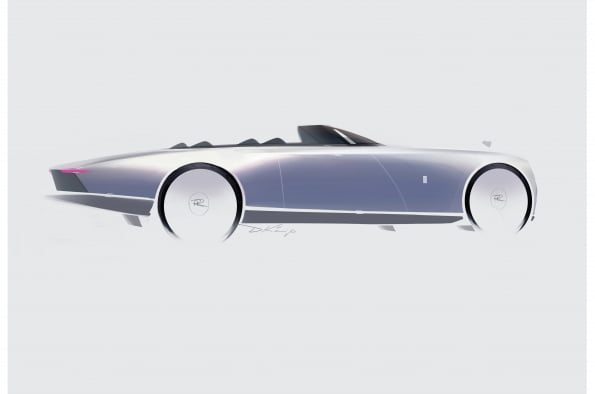
Legendary Italian styling house Touring Superleggera is this year celebrating its 95th anniversary and marking the occasion with a graceful new two-seat coupé appropriately named the Arese RH95 to reflect their commitment to the future at their home of via per Arese, an area long known as the standard-bearer for Italian design, as well as the initials of the Arese project’s founding patron.
The Touring Arese RH95 will receive its UK premiere during the 2021 Salon Privé week. The distinctive design will break with tradition by being the first Touring creation to feature a mid-engined layout.
The company has enjoyed numerous highlights at Salon Privé in recent years, having previously displayed its Bentley Flying Star and award-winning Disco Volante, and in 2014 it picked up Best Concept Car of the Year for its MINI Superleggera Vision. Last year, Touring Superleggera used the magnificent backdrop of Blenheim Palace to introduce its Aero 3, which drew inspiration from the Touring-bodied Alfa 8C 2900 Le Mans Berlinetta. The Aero 3 is still available, giving Touring Superleggera a range of two distinct models for the first time in modern production.
The 95th anniversary design will share many elements with its recent Touring predecessors, as well as their elegant flow and balance of proportions. The Arese RH95 expresses a touch of drama and glamour in all its features, from the novel scissor-hinged doors, the bright aluminium side-slash, the elegant waistline inspired by the Disco Volante to the grille and front air nostril treatment derived from the Aero 3, every flank and panel is a visual delicacy.
All examples of the Touring Arese RH95 will be built around the drivetrain of a well-known exotic, mid-engined donor car, whose active dynamic have been engineered to handle the new body and specifications, to ensure performance and efficiency.
‘The design is both a clear evolution and an enhancement of Touring’s contemporary front-engined Aero family, as exemplified by the Disco Volante Coupé and Spyder and last year’s Aero 3,’ said Emanuele Bedetti, Head of Sales & Marketing at Touring Superleggera. ‘This will be a truly fitting design with which to carry forward the Touring streamline philosophy into the mid-engined genre. The 95th-anniversary supercar is in the final stages of production and we look forward to returning to Salon Privé in September for its UK premiere.’
Salon Privé Director David Bagley said: ‘We are delighted to welcome Touring Superleggera back to Blenheim Palace. The launch of its Aero 3 was one of the highlights of last year’s event. I’m sure the 95th anniversary car will be spectacular, and we are proud to be hosting its UK premiere.’
Founded in Milan in 1926 by Felice Anderloni and Gaetano Ponzoni, Touring produced bodywork for some of the most prestigious marques of the time, including Alfa Romeo and Isotta Fraschini. Following the Second World War, Touring established a close relationship with Ferrari and made bodywork for the 166MM as well as the subsequent 195, 212 and 340MM models. Its ‘Superleggera’ method of producing lightweight bodies was licensed by Aston Martin for its DB4 and DB5, and it also worked with Maserati, Pegaso and Lamborghini.
Still based in Milan, Touring Superleggera now specialises in bespoke projects, and over the past decade it has created everything from the Tornante supercar for Gumpert to the four-seater Maserati-based Sciàdipersia Coupé. It also has a restoration department that ensures Touring-bodied cars are rebuilt to exacting standards of authenticity.
Salon Privé Week 2021 1 September – Salon Privé Concours d’Elégance 2 September – Salon Privé Concours d’Elégance Awards 3 September – Salon Privé Ladies’ Day presented by Boodles 4 September – Salon Privé Club Trophy presented by Lockton 5 September – Salon Privé Classic & Supercar
Tickets can be purchased via the website www.salonpriveconcours.com or by calling the Ticket Hotline: 0808 100 2205.
Charity Partner Salon Privé is proud to once again have Rainbow Trust Children’s Charity as its charity partner. The organisation provides emotional and practical support to families who have a child with a life-threatening or terminal illness, and thanks to the generation donations of guests and Concours entrants, the event has so far raised in excess of £1 million for this great cause.
Exclusive Performance Car Uses Innovative Design And Manufacturing Technologies
Czinger, the trailblazing company that uses an in-house invented Human-AI production system to build state-of-the-art high-performance vehicles, unveiled today its final production spec 21C hypercar.
The 21C expresses the apex of Human-AI creativity.
The Czinger 21C, the first model in a series of exclusive performance vehicles – production will be limited to 80 cars – was created in part using additive manufacturing technologies. Each component manufactured using this technology is computationally engineered using AI, optimized for weight and performance, and is beautifully finished by hand. Czinger’s proprietary manufacturing technologies, in-house developed powertrain, and iconic design will guide its future family of vehicles.
This new hypercar showcases significant updates since its first public introduction in March 2020 ahead of the cancelled Geneva International Motor Show, including an updated width of 2050 mm. With 1250 hp and a dry weight under 1240 kg, the 21C achieves a true 1:1 power-to-weight ratio. It also features all-wheel drive with a strong hybrid powertrain that includes:
An in-house developed 2.88-liter, flat crank V8 with twin turbos located mid-vehicle
Two high output electric motors, each powering a front wheel with torque vectoring
An ultra-light, sequential seven-speed automated manual transmission gearbox
Total output of 1250hp redlining at 11,000 rpm (A 100hp upgrade is offered providing 1350 hp)
The 21C V8 is designed to use a range of fuels, including carbon recycled methanol and other e-fuels, so it can be run as a zero emission vehicle
The 21C’s hybrid powertrain uses the world’s most power dense production IC engine as its foundation. It is a 2.88 liter, flat-plane crank V8 with twin turbos located mid-vehicle. The V8 is coupled with an 800V electric drive and regen system. An e-motor drives each front wheel and the batteries are charged during operation both through regenerative braking and a Motor Generator Unit (MGU) using a gear drive that is attached to the IC engine. The total strong hybrid system delivers a peak output of 1250hp (1233bhp).
The hypercar has a top speed up to 281 mph in optional low drag vmax configuration. Putting the driver and passenger in the center position for ultimate weight distribution, aero and driver engagement, its quarter mile time is 8.1 seconds, and it goes 0 to 62 mph (0 to 100 kph) in 1.9 seconds; 0 to 186 mph (300 kph) to 0 in 13.8 seconds and 0 to 248 mph (400 kph) to 0 in 27.1 seconds; 0 to 186 mph (300 kph) in 8.5 seconds; and 0 to 248 mph (400 kph) in 21.3 seconds. It has a >3:1 Lift / Drag Ratio with 615 kg downforce @ 100mph and 2,500 kg @ 200mph (high downforce configuration).
The hypercar is designed, built, and manufactured in Los Angeles using cutting-edge technology tools that are integrated into a patented production system. This system includes automated AI based design and optimization software, patented additive manufacturing driven processes, high accuracy automated assembly and novel performance materials. This revolutionary technology enables Czinger’s design and engineering team to unlock performance and styling not before seen in the automotive industry.
Computationally engineered, printed and assembled, each component is at the frontier of theoretical performance. For example, the front upper control arm is hollow with internal structures allowing it to achieve significant mass savings compared to a traditional tooled variant, thereby greatly reducing un-sprung mass and further driving the 21C’s dominating performance.
The 21C is highly customizable both from a specification and individual personalization perspective. Presented in two fully homologated specifications, a lightweight high downforce configuration and a low drag configuration, both cars are powered by Czinger’s in-house powertrain and display its iconic design language and in-line seating architecture.
Czinger first unveiled its groundbreaking 21C in 2020 and confirmed that its halo hypercar is just the start of a family of exclusive performance vehicles created for the 21st century – all using the company’s in-house developed design and manufacturing technology and proprietary drivetrain.
1971 Chevrolet Corvette Stingray T-top C3 (454 big-block)
1968 Ford Mustang Fastback GT
1957 Chevrolet Bel Air 4-door ‘Sport Sedan’
There are less than two weeks to go until Classic Car Auctions close their next catalogue with some significant examples of American classics going under the hammer at The London Classic Car Show.
To submit your entry today, the auction house are offering a one-off opportunity to sell your car with a sellers commission of just 2.5% – visit their website now.
Finished in a beautiful Gloss Black with the top half wrapped in Red is this 1966 Ford Galaxie Convertible. This is a simply fabulous example of the 1966 390ci Galaxie, which has been fully restored over 25 years with all mechanical parts replaced, reconditioned, or upgraded. With a striking new interior, the vendor has spent over £25,000 on this example and Classic Car Auctions have sensibly guided this car at £18,000 – £22,000.
Another car included within their sale is 1971 Chevrolet Corvette Stingray T-top C3 (454 big-block). With over £60,000 of restoration over a period of around ten years, this superbly restored ‘big block’ has only three keepers within the last 25 years and has been cherished by their vendor since 2010! This fabulous 3rd-generation Stingray is finished in gleaming Bridgehampton Blue with distinctive chromed side-exit exhausts and is now extremely desirable. Estimated at: £28,000 – £32,000.
Gary Dunne, CCA’s Sales Manager commented “We are absolutely delighted with our growing lot list that we have consigned for our first sale outside of the Midlands with more going live day by day. This is our first auction in 18 months which bidders can attend in person and we can’t wait to safely welcome everyone back”.
Classic Car Auctions are also offering this superbly presented, 1968 Ford Mustang Fastback GT. With matching numbers, this Passion Red 1968 Fastback is optioned from new with the ‘GT Equipment Package’. With the paintwork refreshed by their vendor last year, the car has been fully detailed and is looking simply spectacular. The auction house are offering this exceptional car for £40,000 – £50,000.
The last of four cars to be previewed from the catalogue is this 1957 Chevrolet Bel Air 4-door ‘Sport Sedan’. This is the most sought-after US classic car in the world and will be going under the hammer at The London Classic Car Show, Friday 25th – Sunday 27th June. Finished in a striking Tropical Turquoise and India Ivory – this is a colour scheme that’s edging on the iconic. With a fabulous matching interior, the Bel Air, 4-door is 4.3-litre topped with a chrome Edelbrock filter. Estimated at £18,000 – £22,000.
To submit your entry before Classic Car Auctions close their catalogue on 11th June, talk to classic car specialist about your car and contact the team on 01926 640888 or complete their Value My Classic form here.
Britain’s newest concours d’elegance announces its final class and entrant list
With only six weeks to go before the inaugural event, Auto Royale has this morning announced the full list of entrants in its British International Concours d’Elegance set to take place at Waddesdon Manor from 16 – 18 July. Not since 2004 have the lawns of Waddesdon Manor seen such a fine display of rare automotive beauties, when it last hosted the Louis Vuitton 150th Anniversary Classic. As then, Organisers expect to see thousands of classic and historic car enthusiasts to flock to the French renaissance-styled venue in what some have touted could well be the most impressive and important showcase of concours vehicles to be seen and experienced in the UK this year.
Whilst it is too early to predict which cars might take home the silverware – a beautiful, bespoke collection of trophies created by the master designers at Amalgam Collection – there are some early standouts, today being announced for the first time. A newly-restored 1950 Talbot Lago T26 Grand Sport Coupe by Saoutchik, last seen pre-restoration at Chantilly Arts & Elegance in 2016. Modest by comparison to other Saoutchik designs of the era, it is one of only 36 Grand Sports built and has lived in France, Germany and Belgium prior to joining the Rosso Bianco Collection. Completely different but no less stunning is the 1956 Lancia Florida Berlina by Pinin Farina from the world-famous collection of Corrado Lopresto, a class winner at no less than four European Concours including Villa d’Este.
For pre-war enthusiasts, the concours is notably joined by the Scuderia Ferrari, 1931 Alfa Romeo 8C Spider by Zagato. Not to be confused with the 2020 Salon Prive winner, chassis #2111006, has not seen in public since its class win at the Cartier Style et Luxe at Goodwood Festival of Speed. Its highly successful race career saw it achieve third place in the 1931 Belgian Grand Prix at Spa, winning the drivers’ championship for Ferninando Minoia and Alfa before winning the Coppa Ciano with Tazio Nuvolari piloting, famously coming from 4th to take the lead in the handicap by 44 seconds from Louis Chiron’s Bugatti.
A contender for a highly competitive Preservation Class must surely be the 1937 Rolls-Royce Phantom III Sedanca de Ville by Arthur Mulliner, star of the movie, The Millionairess, alongside Sophia Loren and Peter Sellars. Not seen in the UK since 1950 and originally owned by Raymond Way, its four previous owners have seen it reside in London, Texas, California and South Africa.
Reflecting the true international flavour of Auto Royale, entries have come not only from prominent local owners but also collections in Australia, New Zealand, India, Indonesia, Germany, Switzerland, France, Belgium and Italy.
“It’s been a long time in the making, but it’s truly exciting to finally be able to unveil our complete plans for Auto Royale’s debut event”, say Event Director, Paul Mathers. “Many people have worked tirelessly to curate this collection and bring something we believe is fresh and new to the concours calendar. We are genuinely looking forward to sharing these cars and their stories with the British historic motoring community, and I personally hope that enthusiasts embrace Auto Royale as their own. Everyone is welcome!”.
Auto Royale – the British International Concours d’Elegance – Entrant List
Vintage Class 1912 Rolls-Royce 40/50 “Silver Ghost” Torpedo Phaeton by Barker 1924 Aston Martin 1 ½ L Side Valve Open Four-Seater by Albany 1927 Hispano-Suiza H6B Foursome Coupe by Park Ward 1927 Rolls-Royce Phantom 1928 Bentley 6 ½ L by Vanden Plas 1929 Bentley 4 ½ L “Blower”
Pre-War – Closed Class 1933 SS 1 Coupe 1935 Bentley 3 ½ L Swept Wing Pillarless Coupe by Gurney Nutting 1939 Bentley 4 ¼ L Sports Saloon by Hooper
Pre-War – Open Class 1930 Austin Heavy 12 Tourer (Old Min) 1931 Alfa Romeo 8C 2300 Spider by Zagato 1932 Alfa Romeo 8C 2300 Le Mans by Touring 1934 Alfa Romeo 8C Long Chassis Spider by Brianza 1934 Morgan Supersports MX4 Barrell-Back Cabriolet 1937 Delahaye 135M Drophead Coupe by Abbey 1938 SS 100 Drophead Coupe
Post-War – Closed Class 1950 Talbot Lago T26 Grand Sport Coupe by Saoutchik 1953 Alfa Romeo 1900 C Coupe 1955 Lancia Aurelia “Florida” Coupe by Pinin Farina 1956 Aston Martin DB2/4 Mk II Coupe 1956 Aston Martin DB2/4 Coupe by Vignale 1956 Lancia Aurelia “Florida” Berlina by Pinin Farina 1958 Bentley S1 Continental Fastback 1959 Triumph Italia 2000
Post-War – Open Class 1946 Delahaye 135M Cabriolet by Graber 1948 Talbot Lago T26 Grand Sport Cabriolet by Franay 1954 Lancia Aurelia B24 GT Spider America 1959 Aston Martin DB2/4 Mk III Convertible 1962 Mercedes-Benz 300 SL Roadster
Post-War – Sports / Racing Class 1950 Ferrari 166MM/212 Export Barchetta “Uovo” by Fontana 1950 Frazer Nash Le Mans “Replica” 1951 Ferrari 212 Export Spider by Vignale 1953 Alfa Romeo 6C 3000 PR “Disco Volante” 1954 HWM Cadillac Sports Racer 1955 Aston Martin DB3S Coupe 1955 Porsche 550 Spyder
Classic Class 1961 Facel Vega HK500 Coupe 1963 Aston Martin DB4 Vantage SS 1965 Rolls-Royce Phantom V 7-Passenger Limousine 1968 Ferrari 330 GTC Coupe 1970 Monteverdi 375 High-Speed Coupe 1972 Iso Grifo Coupe 1974 Maserati Quattroporte by Frua 1979 Rolls-Royce Phantom VI Limousine by Mulliner Park Ward
Classic – Performance Class 1960 Aston Martin DB4 GT Coupe 1960 Ferrari 250 GT Coupe by Pinin Farina 1961 Lotus Elite Coupe 1965 Maserati Sebring Coupe 1967 Ferrari 275 GTB/4 Coupe 1973 Ferrari 365 GTB/4 “Daytona” Coupe 1975 Ferrari 365 Berlinetta Boxer
Classic – Sports / Racing Class 1960 Triumph TRS Works Roadster 1962 Ferrari 196SP by Fantuzzi 1963 Abarth Simca 2000GT Corsa 1964 Porsche 904 GTS
Contemporary Class 1985 Aston Martin V8 Vantage Prototype by Zagato 1989 Aston Martin V8 Vantage Volante 1991 Jaguar XJR-15 Coupe 1991 Schuppan 962CR Coupe 1993 Jaguar XJ220 Coupe 2015 Jaguar CX-75 Coupe
Preservation Class 1926 Rolls-Royce Phantom Brougham de Ville “Phantom of Love” by Charles Clark & Son 1933 Rolls-Royce 20/25 Sedanca de Ville by Freestone & Webb 1937 Rolls-Royce Phantom III Sedanca de Ville by Athur Mulliner 1949 Bristol 401 Cabriolet by Pinin Farina
Maharaja Class 1904 Napier L49 1912 Rolls-Royce 40/50 Silver Ghost Tourer 1923 Rolls-Royce 20 HP 1923 Rolls-Royce Barrell-Sided Tourer by Barker 1926 Rolls-Royce Phantom Limousine by Maythorn & Sons 1927 Rolls-Royce 20 HP Tourer by Barker 1930 Delage D8 Cabriolet by Figoni 1930 Rolls-Royce Phantom II Tourer by Barker 1934 Invicta 4 ½ L S-Type Tourer 1949 Bentley Mk VI 4-Light Touring Saloon by Hooper
Scaglietti Class 1954 Ferrari 500 Mondial 1955 Ferrari 750 Monza 1956 Ferrari 290MM / 250TR 1956 Ferrari 500 TR 1957 Ferrari 500 TRC 1960 Ferrari 250 TR “CEGGA” 1962 Ferrari 250 GT SWB Berlinetta 1964 Ferrari 250 GT Lusso Berlinetta 1970 Ferrari 246 GT “Dino” Coupe
Sir William Lyons Class 1950 Jaguar XK 120 OTS Competition 1950 Jaguar XK 120 OTS Competition 1951/53 Jaguar XK120 “Hansgen Special” 1954 Jaguar XK 120 Coupe by Pinin Farina 1957 Jaguar XK 150 by Bertone 1957 Jaguar XKSS 1958 Jaguar XK 150 Coupe 1961 Jaguar E-Type Coupe 1961 Jaguar E-Type Lightweight 1961 Jaguar Mk X
Drogo Class 1962 Ferrari 250 GT SWB “Breadvan” 1963 Ferrari 250 GTE
Morgan’s four-wheeled range receives host of customer-focused updates, enhancing comfort, usability, aesthetics, and acoustic character
The Model Year ‘22 (MY22) update marks the introduction of a cyclical update strategy for Morgan’ core product range
The updates to the product range are based on customer and press feedback, and demonstrate the company’s customer-first philosophy
The MY22 package is headlined by an all-new hood, redesigned seats, and an optional Active Sports Exhaust System
Further standard fit features include USB charging, along with enhanced interior and exterior lighting
New optional features include lockable storage, black painted lower grille, and exhaust tailpipe finish options
The MY22 update also marks the first vehicle application of Morgan’s redesigned ‘wings badge’
Changes to the Morgan Plus Four and Plus Six are effective immediately on all new orders
The Morgan Motor Company continues its programme of customer-focused vehicle enhancement with a host of upgrades for its Plus Four and Plus Six models.
The updates come collectively as part of Morgan’s Model Year ’22 (MY22) package, in the company’s move to a cyclical product enhancement programme. The MY22 update comes following feedback from customers and press alike, and reflects Morgan’s desire to evolve its product and provide tangible customer benefit. It furthermore provides renewed purchase motivation, as part of the company’s wider long-term product strategy.
An all-new hood design leads the MY22 update package, and is designed to improve usability, weather protection, and refinement. This has been achieved through a revised frame structure that eliminates the requirement for hood rail fasteners, and a vastly enhanced seal package around door and sidescreen closures. Together, these changes bring a marked improvement in speed and ease of hood operation, cabin noise insulation, and weather protection.
The MY22 update sees the first usage of Morgan’s redesigned ‘wings badge’ on a vehicle. The iconic logo has received its first update in more than a decade, and the change comes as part of Morgan’s wider brand identity refresh. The badge was designed in-house and is an example of the company’s new level of digital craftsmanship that sits perfectly alongside its famed array of traditional coachbuilding skills. The new badge is complemented by a lower intake mesh that can now be specified with a black finish to match the optional black upper grille mesh.
The engine sound and character is core to the Morgan driving experience, and now customers will be able to enjoy the unrestrained sound of their Plus Four or Plus Six while out on the open road, but with the option of a more subtle acoustic profile in urban environments, thanks to the optional Active Sports Exhaust System. Featuring active bypass valves, the full character of the engine is released when driving in Sport mode (automatic models) and Sport Plus modes. It comes with a choice of polished silver or black tailpipes.
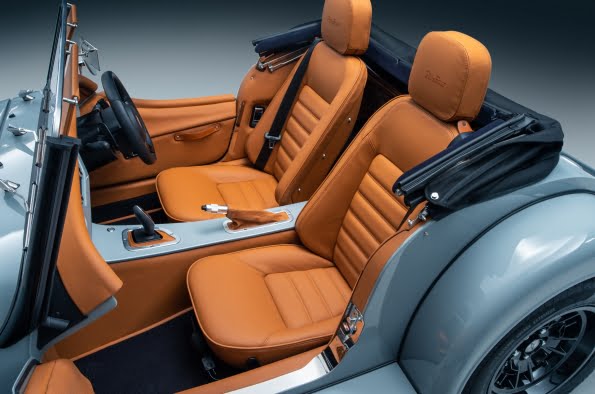
Inside the car, an all-new seat improves comfort, as well as driver confidence during dynamic driving. This has been achieved through reprofiled ergonomic seat padding in the base and backrest, as well as enhanced lateral and longitudinal support. It comes in two forms: the Comfort seat, which comes as standard on the Morgan Plus Four, and features adjustable lumbar support, and the Comfort Plus, which is fitted as standard to the Morgan Plus Six – and is available optionally on the Plus Four – and features increased elasticity in the seat base along with additional pneumatic adjustment to the side and thigh bolsters.
A new lockable storage compartment is now available as an option on both the Plus Four and Plus Six. Fitted to the rear of the luggage compartment, it provides secure stowage for valuable items when the car is left unattended, with no impact on the existing storage capacity or occupant space.
Additional interior lighting is provided by the standard fitment of a pair of LED lights to the rear bulkhead, a further useability enhancement to the MY22 models. A concierge function has been incorporated into the headlights, too, keeping them illuminated for 30 seconds after the key has been removed from the ignition.
The addition of a dual USB outlet as standard represents a further passenger convenience feature, and when combined with the existing Bluetooth audio connectivity facilitate seamless mobile device integration for navigation and in-car entertainment.
Steve Morris, Chairman and CEO of Morgan Motor Company, said: “For 112 years Morgan has listened to its customers, offering a bespoke service that has made it famous the world over. Today, that’s as much the case as it ever was, and feedback on the Plus Four and Plus Six, which were launched in 2020 and 2019 respectively, has been carefully collated and acted on by our engineering team.
“The result of this engineering programme is the MY22 update package, which holistically brings new levels of usability, refinement and driving enjoyment to the four-wheeled range. The introduction of a cyclical structure to product improvement also demonstrates the progress the company has made in recent years and its new levels of commercial maturity.”
Rolls-Royce Coachbuild to become a permanent fixture in future portfolio
Based on a true commission model, ‘Boat Tail’ represents a collaborative exploration of luxury, design and culture between the marque and commissioning clients
Coachbuild empowers clients to create potent evocative expressions of personal taste
Rolls-Royce Coachbuild is contemporary patronage in its truest form
Rolls-Royce prompted the contemporary coachbuilding movement in 2017 with the introduction of ‘Sweptail’
“Today marks a seminal moment for the House of Rolls-Royce. We are proud to unveil Rolls-Royce Boat Tail to the world, and with it, the confirmation of coachbuilding as a permanent fixture within our future portfolio.
“Historically, coachbuilding had been an integral part of the Rolls-Royce story. In the contemporary Rolls-Royce narrative, it has informed our guiding philosophy of Bespoke. But it is so much more. Rolls-Royce Coachbuild is a return to the very roots of our brand. It represents an opportunity for the select few to participate in the creation of utterly unique and truly personal commissions of future historical significance.
“Rolls-Royce has carefully listened to its closest clients, each of whom has expressed a desire to deepen their relationship with the brand by creating ambitious, personal statements of true luxury. Rolls-Royce Boat Tail is not a concept created to be retrospectively sold.
“Quite the contrary. Rolls-Royce believes in complete authenticity and Boat Tail is the culmination of a four-year collaboration with three of our most special clients.
“Rolls-Royce Coachbuild clients are intimately and personally involved at each step of the creative and engineering process. We work in harmony with the client to gain complete fluency in the nuances of their character and personality. We carefully translate these qualities into the elements with which they wish to imbue their commission.
“Only the House of Rolls-Royce can offer its Coachbuild clients the inimitable opportunity to commission a product of future historical significance, that is as fundamentally unique as they are – and then participate in every detail of its creation.
“This is authentic luxury. This is contemporary patronage in its truest form. This is Rolls-Royce Coachbuild.”
“Rolls-Royce Boat Tail challenges the notion of what a motor car is and creates a new definition of what a motor car means. Boat Tail exists far beyond a mere means of transport. It is not just the method to reach a destination, but the destination itself. It is an ambition realised with a remarkable cohort of women and men who empowered the marque to create a concept of extraordinary scope.
“Coachbuild provides freedom to move beyond the usual constraints. Normally, there is a natural ceiling to Rolls-Royce Bespoke by way of the canvas. At Rolls-Royce Coachbuild we break through that ceiling, embracing the freedom of expression afforded by coachbuilding to shape a concept directly with our commissioning patrons.
“With Boat Tail we have achieved this. We have created a trio of exceptional cars which, although they share a common body style, are each imbued with the unique, highly personal imprint of the commissioning patron, thereby telling differing stories. Boat Tail is unprecedented. Boat Tail is a distinct counterpoint to industrialised luxury.”
Alex Innes, Head of Rolls-Royce Coachbuild Design, Rolls-Royce
As a House of Luxury, Rolls-Royce imbues its products with meaning. A Rolls-Royce serves as a canvas onto which clients reflect their personal tastes, express ambitions and often, define legacies. The Bespoke treatment of a Rolls-Royce elegantly reflects its status as ‘the best car in the world’ while stylishly expressing the personality of its commissioning client.
Ever increasingly, clients appreciate and enjoy the marque’s Bespoke capabilities and Rolls-Royce is called upon, by its clients, to integrate itself into their lives in meaningful ways. The brand and its clients have become progressively closer and the designers, engineers and craftspeople at the Home of Rolls-Royce, a Global Centre of Luxury Manufacturing Excellence, have developed a unique fluency in interpreting the lifestyles of these remarkable women and men. This evolution of mutual confidence has resulted in ever more ambitious commissions, reaching well beyond the scope of Bespoke competencies and capacity, into the rarefied realm of coachbuilding. To fulfil these extraordinary client commissions Rolls-Royce has reached a decision to return to one of the historical roots of the marque and to initiate a distinct department within the company, Rolls-Royce Coachbuild.
Coachbuilding is a highly distilled expression of Rolls-Royce Bespoke and is reserved for those who look to move beyond existing constraints. It is based on a true commission model and represents a collaborative exploration of meaningful luxury, design and culture between the marque and its commissioning client. The results become pivotal moments in time that create a future historical legacy, advancing designs which in turn define an era, extending influence far beyond the original intended purpose of a mere means of transportation.
Rolls-Royce Coachbuild is contemporary patronage in its truest form.
The discipline inherent in Rolls-Royce’s approach to coachbuilding requires elite artistic skills that do not exist elsewhere in the automotive industry. Commissioning clients demand an object that is truly transformative; an object that makes a permanent statement and sets itself apart from anything that has gone before.
In response, the marque must interrogate and deeply understand two worlds. The first is the intimately personal context of the client – their individual life-space, how they celebrate, what and who they surround themselves with, and the experiences that have defined the very best moments in these exceptional people’s lives. The second is the broader cultural context in which a Coachbuild car will exist. Here the marque explores the cultural nuances of the client, movements in architecture, couture, colour palettes, artistic tastes – even hospitality.
THE DAWN OF A MOVEMENT
In 2017, the celebrated Rolls-Royce Sweptail defined the dawn of the contemporary coachbuilding movement. It created a definitive moment that raised the awareness of a new watermark in luxury and automotive possibility, illustrating a new realm of exploitation owing to its hand-built nature. This remarkable product, which was instantly proclaimed as one of the finest intercontinental tourers in history, represented a major recalibration of possibility, and confirmed that the legacy of Rolls-Royce will be defined in collaboration with its clients.
Sweptail set a new waterline of potential and ignited a fascination among a rarefied cohort: collectors, patrons of the arts and commissioning clients of now-iconic architecture. A number of these women and men approached Rolls-Royce to discover if they too could collaborate on a unique commission, one that was even more profound – one that provided an elevated sense of curation. The marque agreed, signalling the genesis of a permanent contemporary Coachbuild department at the Home of Rolls-Royce.
Within this group, it emerged that three potential patrons shared a deep appreciation of contemporary nautical design. J-Class yachts were often referenced as points of inspiration, both for their purity of form and their requirement for hand craftsmanship at the highest level to will them into existence.
This client-led creative expression coincided with a long-held ambition of the design team at Rolls-Royce to create a contemporary expression of the Boat Tail typology, where coachbuilders would graft the hull forms of sailing boats onto the rolling chassis of a Rolls-Royce. When the idea of this design direction was proposed, the three patrons were unequivocal in their approval. And all three shared a single demand: “Show me something that I have never seen before.”
In consultation with the clients concerned, an agreement was reached whereby three cars would share a common body, but each would then be individually, highly personalised, reflecting the confluence between vision, capability and ambition of the marque and each of the individual commissioning patrons.
Rolls-Royce Boat Tail was conceived.
THE TRANSFERENCE OF SOUL
The manual techniques of coachbuilding offer new realms of design opportunity. Once the preliminary design proposal is penned by hand, the discovery of the form is enabled with a full-sized sculpture in clay, allowing hand-crafted manipulation of the expansive surfaces to perfect its shape. Throughout this process, the clients were invited to envisage the scope of the collaboration and influence its direction. Cutting-edge engineering technologies within Rolls-Royce are fused with the artistic practice of coachbuilding to exploit new possibilities. The clay sculpture is digitally remastered, from which the buck, is created on to which aluminium sheets are hammer-formed by hand.
Employing age-old individual hand skills and craft, a living canvas is created from metal –honing and optimising the aluminium body, creating a clarity of surface and continuation of line that is unable to be achieved by machine alone.
The process is akin to yacht building, easing the transference of soul into the creation. A process of hand refinement is repeated almost endlessly, without the pressure of time. Slowly, vast sheets of metal transform into the sculptural representation of Boat Tail. A truly pure form is created: uninterrupted by panel breaks, dramatic in its curvature, monolithic in scale and formed from one seemingly endless surface.
A CELEBRATION OF SUCCESS
The first Rolls-Royce Boat Tail, unveiled today, is a curation of exceptional thoughts, concepts and items, which culminate to form the clients’ perfect experience. The commissioning patrons, a globally successful couple who are highly proficient in the appointment of Rolls-Royces, truly personify connoisseurship; their luxury curation is an artform in itself. Their proposition was purposefully self-indulgent. Their desire was to create a response to a life of hard work, success achieved, and celebration required. Their Rolls-Royce Boat Tail should be joyful, a celebratory car to enjoy with their family.
Together, with the marque’s designers, they embarked on an intellectual journey, founded on a long-standing and creative relationship with the brand. Indeed, the clients’ fascination of the Boat Tail form was furthered by a motor car in their private collection; a 1932 Rolls-Royce Boat Tail, lovingly restored, by them, in time for their modern Boat Tail’s completion.
Rolls-Royce Boat Tail presents a wonderful new aesthetic for the marque, balancing previously unseen levels of sculpture with discrete, sometimes playful functionality. The creation tells the romantic tale of Rolls-Royce’s history, echoing a Boat Tail design but not explicitly mimicking it, fusing an historical body type with a thoroughly contemporary design.
At nearly 5.8m long, its generosity of proportion and clarity of surface present a graceful and relaxed stance. The front profile is centred on a new treatment of Rolls-Royce’s iconic pantheon grille and lights. The grille becomes an integral part of the front end, not an applique; a freedom of design bestowed only upon models within the Coachbuild portfolio. This progressive treatment softens Rolls-Royce’s familiar formality while retaining the marque’s undeniable presence. A strong horizontal graphic with deep-set daytime running lights forms Boat Tail’s intense brow line and frames classical round headlamps, a design feature recalled from the design archives of Rolls-Royce.
In profile, nautical references are very suggestive. The wrap-around windscreen recalls the visor on motor launches, while the gentle rearward lean of the A-pillar, the large, crisp volumes at the front and the tapered rear create a gesture that recalls a motor launch rising out of water under power. A progressive negative sculpture in the lower bodyside creates a lithe impression, while making an historical reference to the running boards of prominent heritage Rolls-Royce designs.
Viewed from dead rear, the body resolves in a gentle sharpening of the form. As with the front, a horizontal emphasis is established at the rear with wide, deep-set lamps – a break from the expected vertical Rolls-Royce lamp iconography.
Indeed, it is at the rear where the nautical references become more apparent. The aft deck, a modern interpretation of the wooden rear decks of historical Boat Tails, incorporates large swathes of wood. Caleidolegno veneer is applied in a feat of Rolls-Royce engineering; the grey and black material which is typically housed in the interior, has been specially adapted to be used on the exterior, with no compromise to the aesthetic.
The open pore material features a linear wood grain which is visually elongated by brushed stainless steel pinstripe inlays, serving as an optical nod to the typical wooden construction of yachts – both old and new. The honed skills of Rolls-Royce’s wood specialists have manipulated and book-matched the grain so as to contract with the geometry of the car. The veneer treatment extends to the lower transom area resolving the taper and overall volume astern. This bold truncation is a subtle reference to the hull lines of classic Boat Tail bodies.
From the rear, one perceives a strong graphical composition marked by further horizontal emphasis, accentuating Boat Tail’s great width. Deep-set lamps establish a dramatically low reference point, evoking the dipped stern and proud bow of a motor launch under power and on plane.
An explicit architectural influence is discovered in Boat Tail’s unconventional fixed-canopy roof. Adding to the sculptural form, the sweeping roofline concludes in delicate structural elements that touch down on the rear, redolent of flying buttresses. Of course, if inclement weather is encountered while the roof is removed, a temporary tonneau is stowed for static transitory shelter.
A MUSE IN BLUE
The exterior of Rolls-Royce Boat Tail is swathed in a rich and complex tone of the client’s favourite colour – blue. The hue, with an overt nautical connotation, is subtle when in shadows but in sunlight, embedded metallic and crystal flakes bring a vibrant and energetic aura to the finish. To ensure the smoothest possible application when rendering the exterior, a finger was run over the definitive body line before the paint had fully dried to soften its edges. The wheels are finished in bright blue, highly polished and clear coated to add to Boat Tail’s celebratory character.
A hand-painted, gradated bonnet, a first for Rolls-Royce, rises from a comparatively subdued deeper blue which cascades onto the grille, providing a progressive but informal aesthetic and a solidity of overall volume when viewed from the front.
The interior leather reflects the bonnet’s colour tone transition with the front seats swathed in the darker blue hue, recognising Boat Tail’s driver focused intent, while the rear seats are finished in the lighter tone. A soft metallic sheen is applied to the leather to accentuate its pairing with the painted exterior while detailed stitching and piping is applied in a more intense blue inspired by the hands of the car’s timepieces. A brilliant blue is also found woven at a 55 degree angle into the technical fibre elements to be seen on the lower bodywork, precisely orientated to emulate the spill of a water’s wake.
The fascia is distilled in its appearance, purposefully reduced to provide a modern aesthetic. This minimalist canvas accentuates the jewel like features of the completely unique BOVET 1822 timepieces specifically commissioned by the client for Boat Tail (see below). Collecting pens is another of the clients’ great passions. A particularly cherished Montblanc pen will reside in a discretely placed, hand-crafted, case of aluminium and leather, in Boat Tail’s glove box.
The instrument panel dials are adorned with a decorative technique named Guilloché, more commonly perfected in the workshops of fine jewellers and watchmakers. An elegant, thin rimmed two-tone steering wheel then bears the colours of the commission.
The tactility of the open pore Caleidolegno is brought into the cabin. Anthracite in colour, the veneer brings modern strength and depth to offset the softness of the light blue and metallic sheen. The wood is applied to the lower cabin and floor area, reminiscent of wooden hull forms, again, at 55 degrees, perfectly book matched on centre line providing a uniform appearance when viewed from either side.
A SENSE OF OCCASION
“This car should mark a sense of occasion and serve that occasion like nothing else”.
Such was the brief of Rolls-Royce Boat Tail’s commissioning patrons. In response and in reflection of their character, the rear deck inconspicuously houses a highly ambitious concept never seen before in the automotive world. At the press of a button, the deck opens in a sweeping butterfly gesture, to reveal an intricate and generous hosting suite. Its complex movement was inspired by cantilever concepts explored by renowned architect Santiago Calatrava.
The hosting suite creates a celebratory focal point for a shared occasion and affords ample opportunity to reveal the individuality of the clients’ tastes and desires. It harbours an abundance of surprises executed to the highest quality. Expressed in a celebratory fashion, subverting the very notion of the motor car, the hosting suite surprises and delights all who come to experience it.
Hinged towards the centre line, the synchronised balletic opening movement reveals a treasure chest of moving parts that offer themselves to the host at a precise angle of 15 degrees. This subtle gesture of presentation reflects a genteel and quintessentially British expression of service.
The chest is appointed with the perfect accoutrements for a true Rolls-Royce al fresco dining experience; one side dedicated to aperitifs, the other, cuisine, complete with cutlery engraved with the name ‘Boat Tail’, made by Christofle in Paris.
A double refrigerator has been developed to house the clients’ favourite vintages of Armand de Brignac champagne. Elegant cradles were created to stow the specific bottle size within the refrigerator, the surrounds are highly polished and colour matched to the bottle.
While champagne is a familiar trope in the luxury world, Boat Tail’s client had a particular affinity with fine wine. The husband of this couple recalled a story from his humble beginnings. A great friend of his was a sommelier in his hometown and educated him in the taste profiles of various Grandes Marques de Champagne. This became a life-long education that turned into one of the most informed collections of rare Grand Cru champagnes in the world. The requirement for this knowledge and passion to be shared through the client’s Boat Tail was paramount – as was the need for this champagne to be rapid-cooled to precisely six degrees – the optimum serving temperature of the preferred vintage.
A classic design element of contemporary Rolls-Royce motor cars is the stowage of Rolls-Royce umbrellas in the doors, in anticipation of possible poor weather. In a delightful twist and to heighten the languid experience of Boat Tail, a unique parasol is housed beneath the rear centre line in anticipation of fine weather. A telescopic movement opens this beautiful and whimsical canopy inversely, ensuring effortless deployment.
Cocktail tables, which elegantly rotate to mimic the offering of an attendant, open on either side of the hosting suite providing access to two highly contemporary minimalist stools, which are discretely stowed below. Designed by Rolls-Royce and created by Italian furniture maker Promemoria, the slim-line interlocking stools are formed from the same technical fibre found on the exterior of the car. The interior blue Rolls-Royce leather provides the stools’ suitably comfortable seating materials.
TIMELESS PASSION – A COLLABORATION WITH BOVET 1822
In a move that further demonstrates the clients’ visionary approach to contemporary patronage, two great luxury Houses with a common pursuit of perfection have been brought together at the clients’ behest. World-class craftspeople from the House of BOVET 1822, which was founded on the philosophy of ingenuity and engineering, were called upon to work hand-in-hand with Rolls-Royce’s own masters in their field.
The mechanically minded clients sought to break new ground in horology. As esteemed and passionate collectors of both the Swiss-based House of BOVET and Rolls-Royce, their vision was to create exquisite, ground-breaking timepieces for their Boat Tail. In an act of tireless endeavour and genuine collaboration, the Houses have come together to re-imagine Rolls-Royce’s iconic centrepiece, the dashboard clock.
The result is an accomplishment never before realised in either industry. Two fine reversable timepieces, one for the lady and one for the gentleman, have been designed to be worn on the wrist, or, placed front and centre within Boat Tail’s fascia as the motor car’s clock.
The two-sided timepieces required Rolls-Royce and BOVET 1822 to work side by side over the course of three years to develop a ground-up remastering of the Amadeo convertible system, the most complex undertaken to date. The result is a true reflection of BOVET’s mastery, allowing for the bespoke tourbillon timepieces’ inclusion in the motor car.
Pascal Raffy, owner, BOVET 1822, commented, “I am so proud of the BOVET 1822 team, who worked in tandem with the elite design team at Rolls-Royce to produce something spectacular. These two pieces, and the mounting system, are completely unique and unlike anything we have ever done before.”
The story behind the creation of these remarkable works of art, and a detailed exploration of their mechanisms, together with information on the precious materials, unique micro-sculptures and the vast complexity of the watch carrier will be shared via a press release on 8 June, 2021 at 1pm BST.
AN ENGINEERING MARVEL
To fulfil the clients’ extraordinary ambitions, significant engineering challenges were overcome in the development of Rolls-Royce Boat Tail. Indeed, 1813 completely new parts were created specifically for the cars. Time, patience, dedication and passion were the project’s hallmarks. To complete the preliminary engineering phase, prior to the commencement of production, a total of over 20 collective years were expended.
While designs were being finalised with the clients, the marque’s body-in-white, with its scalable aluminium spaceframe architecture, was completely reconfigured to support Boat Tail’s generous proportions, a process that took eight months in itself. As ever, the 15-speaker Bespoke Rolls-Royce Audio System was intended from the motor car’s inception, but the spaceframe architecture was exploited differently. Rolls-Royce’s existing product portfolio use a specially designed sill section of the architecture as the resonance chambers for the sound system’s bass speakers. In Boat Tail, the entire floor structure is utilised, creating an exceptional audio experience for the client.
To support the complex requirements of the hosting suite to the rear of Boat Tail, a unique electronic treatment was required. Five electronic control units (ECUs) were created for the rear of the car alone – a process that required a completely redesigned, dedicated wiring harness, which was the product of nine months of intensive research and development. Only then was it possible for the aft deck lids to open to an appropriate 67-degree angle, incorporate a highly secure locking mechanism and integrate a total climate control system to the rear hosting suite to preserve any cuisine stowed on board.
Indeed, the inside temperature of the hosting suite was a specific consideration. Boat Tail was created in anticipation of fair weather, so measures needed to be taken to ensure that heat absorption did not adversely affect the contents of the suite, which could include food, liquids and of course champagne. To that end, two fans are mounted in the lower section of the hosting suite to dissipate heat. To confirm this and to ensure that Boat Tail’s hosting suite will acquit itself in all climates, it has been rigorously and successfully tested to 80 degrees Celsius and -20 degrees Celsius.
As Boat Tail is a fully homologated, road-legal motor car that was created to be driven, it was only fully released by the marque once it had undergone the same rigorous dynamic testing as all other Rolls-Royces, including high speed analysis to ensure the contents of the rear hosting suite are sufficiently fastened and therefore silent under power. Indeed, each client has stipulated that they wish to drive their Boat Tail immediately upon receipt.
Torsten Müller-Ötvös, concluded, “Boat Tail is the culmination of collaboration, ambition, endeavour, and time.It was born from a desire to celebrate success and create a lasting legacy. In its remarkable realisation, Rolls-Royce Boat Tail forges a pivotal moment in our marque’s history and in the contemporary luxury landscape.”